Q17 / 75 · JEE Main 2025 (28 Jan Shift 2) · Chemistry
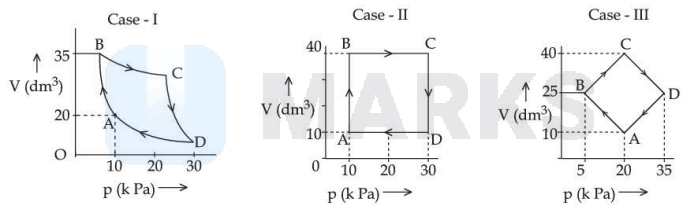
An ideal gas undergoes a cyclic transformation starting from the point $A$ and coming back to the same point by tracing the path $\mathrm{A} \rightarrow \mathrm{B} \rightarrow \mathrm{C} \rightarrow \mathrm{D} \rightarrow \mathrm{A}$ as shown in the three cases above.
Choose the correct option regarding $\Delta \mathrm{U}$ :
An ideal gas undergoes a cyclic transformation starting from the point $A$ and coming back to the same point by tracing the path $\mathrm{A} \rightarrow \mathrm{B} \rightarrow \mathrm{C} \rightarrow \mathrm{D} \rightarrow \mathrm{A}$ as shown in the three cases above. Choose the correct option regarding $\Delta \mathrm{U}$ :
- Correct answerA$\Delta \mathrm{U}($ Case-I $)=\Delta \mathrm{U}($ Case-II $)=\Delta \mathrm{U}($ Case-III $)$
- B$\Delta \mathrm{U}($ Case-I $)\gt\Delta \mathrm{U}($ Case-III $)\gt\Delta \mathrm{U}($ Case-II $)$
- C$\Delta \mathrm{U}($ Case-III $)\gt\Delta \mathrm{U}($ Case-II $)\gt\Delta \mathrm{U}($ Case-I $)$
- D$\Delta \mathrm{U}($ Case-I $)\gt\Delta \mathrm{U}($ Case-II $)\gt\Delta \mathrm{U}($ Case-III $)$
Solution
As internal energy ' $U$ ' is a state function, its cyclic integral must be zero in a cyclic process
$\therefore \Delta U \text { case }(I)=\Delta U \text { case }(\text { II })=\Delta U \text { case }(\text { III })$
Hence, the correct answer is option: 'A'.