Q136 / 200 · NEET 2003 · Physics
An equiconvex lens is cut two halves along (i) XOX' and (ii) YOY' as shown in the figure. Let $f, f^{\prime}, f^{\prime \prime}$ be the focal length of the complete lens, of each half in case (i) and each half in case (ii), respectively.
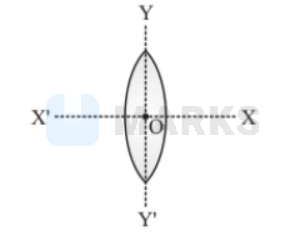 Choose the correct statement from the following:
- Correct answerA$f^{\prime}=f, f^{\prime \prime}=2 f$
- B$f^{\prime}=2 f, f^{\prime \prime}=f$
- C$f^{\prime}=f, f^{\prime \prime}=f$
- D$f=2 f, f^{\prime \prime}=2 f$
Solution
Since the lens is equiconvex, the radius of curvature of each half is same.
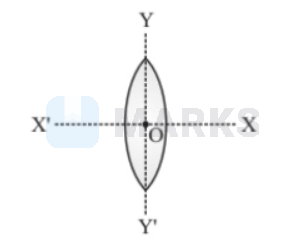
Using lens maker formula $$ \frac{1}{f}=(\mu-1)\left(\frac{1}{R_1}-\frac{1}{R_2}\right) $$ Here $R_1=R$ $R_2=-R$ by convection $$ \therefore \frac{1}{f}=(\mu-1) \frac{2}{\mathrm{R}}(\mu-1) \frac{1}{\mathrm{R}}=\frac{1}{2 f} \ldots(\mathrm{i}) $$ If we cut the lens along $\mathrm{XOX}^{\prime}$ then two halves of the lens will be having the same radii of curvalur and $$ \begin{aligned} & R_1=R, R_2=-R \\ & \therefore \frac{1}{f^{\prime}}=(\mu-1)\left(\frac{2}{R}\right) \\ & \Rightarrow \frac{1}{f^{\prime}}=\frac{2}{2 f}=\frac{1}{f} \end{aligned} $$ From (i) it is clear that $f^{\prime}=f$ But when we cut along $\mathrm{YOY}$ ' then $$ \begin{aligned} & R_1=R \text { and } R_2=\infty \\ & \therefore \infty \frac{1}{f^{\prime \prime}}=(\mu-1)\left(\frac{1}{R}-\frac{1}{\infty}\right) \\ & =(\mu-1) \frac{1}{R}=\frac{1}{2 f} \\ & \Rightarrow \quad f^{\prime \prime}=2 f \end{aligned} $$
Using lens maker formula $$ \frac{1}{f}=(\mu-1)\left(\frac{1}{R_1}-\frac{1}{R_2}\right) $$ Here $R_1=R$ $R_2=-R$ by convection $$ \therefore \frac{1}{f}=(\mu-1) \frac{2}{\mathrm{R}}(\mu-1) \frac{1}{\mathrm{R}}=\frac{1}{2 f} \ldots(\mathrm{i}) $$ If we cut the lens along $\mathrm{XOX}^{\prime}$ then two halves of the lens will be having the same radii of curvalur and $$ \begin{aligned} & R_1=R, R_2=-R \\ & \therefore \frac{1}{f^{\prime}}=(\mu-1)\left(\frac{2}{R}\right) \\ & \Rightarrow \frac{1}{f^{\prime}}=\frac{2}{2 f}=\frac{1}{f} \end{aligned} $$ From (i) it is clear that $f^{\prime}=f$ But when we cut along $\mathrm{YOY}$ ' then $$ \begin{aligned} & R_1=R \text { and } R_2=\infty \\ & \therefore \infty \frac{1}{f^{\prime \prime}}=(\mu-1)\left(\frac{1}{R}-\frac{1}{\infty}\right) \\ & =(\mu-1) \frac{1}{R}=\frac{1}{2 f} \\ & \Rightarrow \quad f^{\prime \prime}=2 f \end{aligned} $$
Hence, the correct answer is option: 'A'.