Q29 / 59 · NEST (NISER) 2020 (Session 1) · Chemistry
An alkyl halide with $\beta$-hydrogen atom, when treated with a nucleophile/base, undergoes a substitution reaction or an elimination reaction, depending on the strength and size of the nucleophile/base and the reaction conditions.
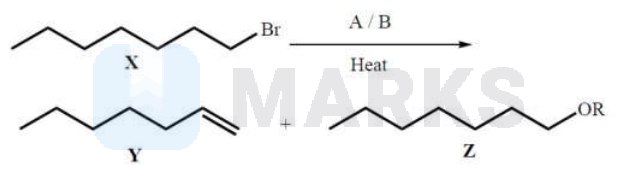
For the above reaction, the correct statement(s) is(are):
For the above reaction, the correct statement(s) is(are):
- AWhen $\mathrm{A}=\mathrm{CH}_3 \mathrm{ONa}$ and $\mathrm{B}=\mathrm{HOH}, \mathrm{Z}$ with $\mathrm{R}=-\mathrm{CH}_3$ is the major product.
- Correct answerBWhen $\mathrm{A}=\left(\mathrm{CH}_3\right)_3 \mathrm{CONa}$ and $\mathrm{B}=\left(\mathrm{CH}_3\right)_3 \mathrm{COH}, \mathrm{Y}$ is the major product.
- Correct answerCWhen $\mathrm{A}=\mathrm{CH}_3 \mathrm{COONa}$ and $\mathrm{B}=\mathrm{CH}_3 \mathrm{COOH}, \mathrm{Z}$ with $\mathrm{R}=-\mathrm{COCH}_3$ is the major product.
- DWhen $\mathrm{A}=\mathrm{CH}_3 \mathrm{ONa}$ and $\mathrm{B}=\mathrm{CH}_3 \mathrm{OH}, \mathrm{Y}$ is the major product.
Hence, the correct answer is options: 'B', 'C'.