Q248 / 270 · NDA 2012 (Phase 2) · Mathematics
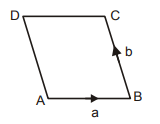
ABCD is a parallelogram. If $\overrightarrow{\mathrm{AB}}=\vec{a}, \overrightarrow{\mathrm{BC}}=\vec{b}$, then what is $\overrightarrow{\mathrm{BD}}$ equal to?
- A$\vec{a}+\vec{b}$
- B$\vec{a}-\vec{b}$
- C$-\vec{a}-\vec{b}$
- Correct answerD$-\vec{a}+\vec{b}$
Solution
$\overrightarrow{\mathrm{BC}}=\overrightarrow{\mathrm{AD}}$
$\overrightarrow{\mathrm{AB}}+\overrightarrow{\mathrm{BD}}=\overrightarrow{\mathrm{AD}}$
$\therefore \quad \overrightarrow{\mathrm{BD}}=\overrightarrow{\mathrm{AD}}-\overrightarrow{\mathrm{AB}}$
$\Rightarrow \quad \bar{b}-\bar{a}$.
Hence, the correct answer is option: 'D'.