Q41 / 110 · VITEEE 2022 · Mathematics
\(\mathrm{ABC}\) is a triangle and \(\mathrm{P}\) is any point on \(\mathrm{BC}\) such that \(\overrightarrow{P Q}\) is the resultant of the vectors \(\overrightarrow{\mathrm{AP}}, \overrightarrow{\mathrm{PB}}\) and \(\overrightarrow{\mathrm{PC}}\), then
- Athe position of \(Q\) depends on position of \(P\)
- Correct answerB\(Q\) is a fixed point
- C\(\mathrm{Q}\) lies on \(\mathrm{AB}\) or \(\mathrm{AC}\)
- DNone of these
Solution
We have \(\overrightarrow{\mathrm{PQ}}=\overrightarrow{\mathrm{AP}}+\overrightarrow{\mathrm{PB}}+\overrightarrow{\mathrm{PC}}\)
\(\begin{aligned}
& \Rightarrow \overrightarrow{\mathrm{PQ}}=\overrightarrow{\mathrm{AB}}+\overrightarrow{\mathrm{PC}} \\
& \Rightarrow \overrightarrow{\mathrm{AB}}=\overrightarrow{\mathrm{PQ}}-\overrightarrow{\mathrm{PC}}=\overrightarrow{\mathrm{PQ}}+\overrightarrow{\mathrm{CP}} \\
& =\overrightarrow{\mathrm{CP}}+\overrightarrow{\mathrm{PQ}}=\overrightarrow{\mathrm{CQ}} .
\end{aligned}\)
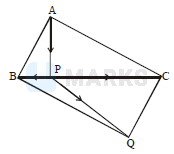
\(\therefore \mathrm{AB}=\mathrm{CQ}\) and \(\mathrm{AB} \| \mathrm{CQ}\) \(\therefore \mathrm{ABQC}\) is a parallelogram. \(\therefore \mathrm{Q}\) is a fixed point.
\(\therefore \mathrm{AB}=\mathrm{CQ}\) and \(\mathrm{AB} \| \mathrm{CQ}\) \(\therefore \mathrm{ABQC}\) is a parallelogram. \(\therefore \mathrm{Q}\) is a fixed point.
Hence, the correct answer is option: 'B'.