Q138 / 150 · MHT CET 2026 (11 April Shift 2) · Physics
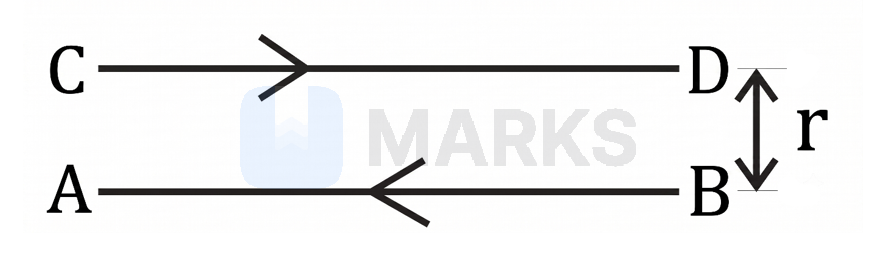
A wire AB is carrying steady current $I_1$ and is kept on the table. Another wire CD carrying current $I_2$ is held directly above as shown in figure. When the wire CD is left free and it remains suspended at its position, its mass per unit length is (g=acceleration due to gravity, $\mu_0$ = permeability of free space)
- Correct answerA$\dfrac{\mu_0 I_1 I_2}{2\pi r g}$
- B$\dfrac{\mu_0 I_1 I_2}{4\pi r g}$
- C$\dfrac{\mu_0 I_1 I_2}{\pi r g}$
- D$\dfrac{\mu_0 I_1 I_2}{\pi r^2 g}$
Solution
The magnetic force per unit length between two parallel wires carrying currents $I_1$ and $I_2$ separated by a distance $r$ is given by:
$F_m = \dfrac{\mu_0 I_1 I_2}{2\pi r}$
Since the currents in wires AB and CD are in opposite directions, the magnetic force between them is repulsive. This upward force on wire CD balances its downward gravitational force.
Let $\lambda$ be the mass per unit length of wire CD. The weight per unit length is:
$F_g = \lambda g$
For wire CD to remain suspended in equilibrium, the magnetic force per unit length must equal the weight per unit length:
$F_m = F_g$
$\dfrac{\mu_0 I_1 I_2}{2\pi r} = \lambda g$
$\lambda = \dfrac{\mu_0 I_1 I_2}{2\pi r g}$
Answer: $\dfrac{\mu_0 I_1 I_2}{2\pi r g}$
Hence, the correct answer is option: 'A'.