Q162 / 200 · MHT CET - Medical 2026 (23 April Shift 1) · Physics
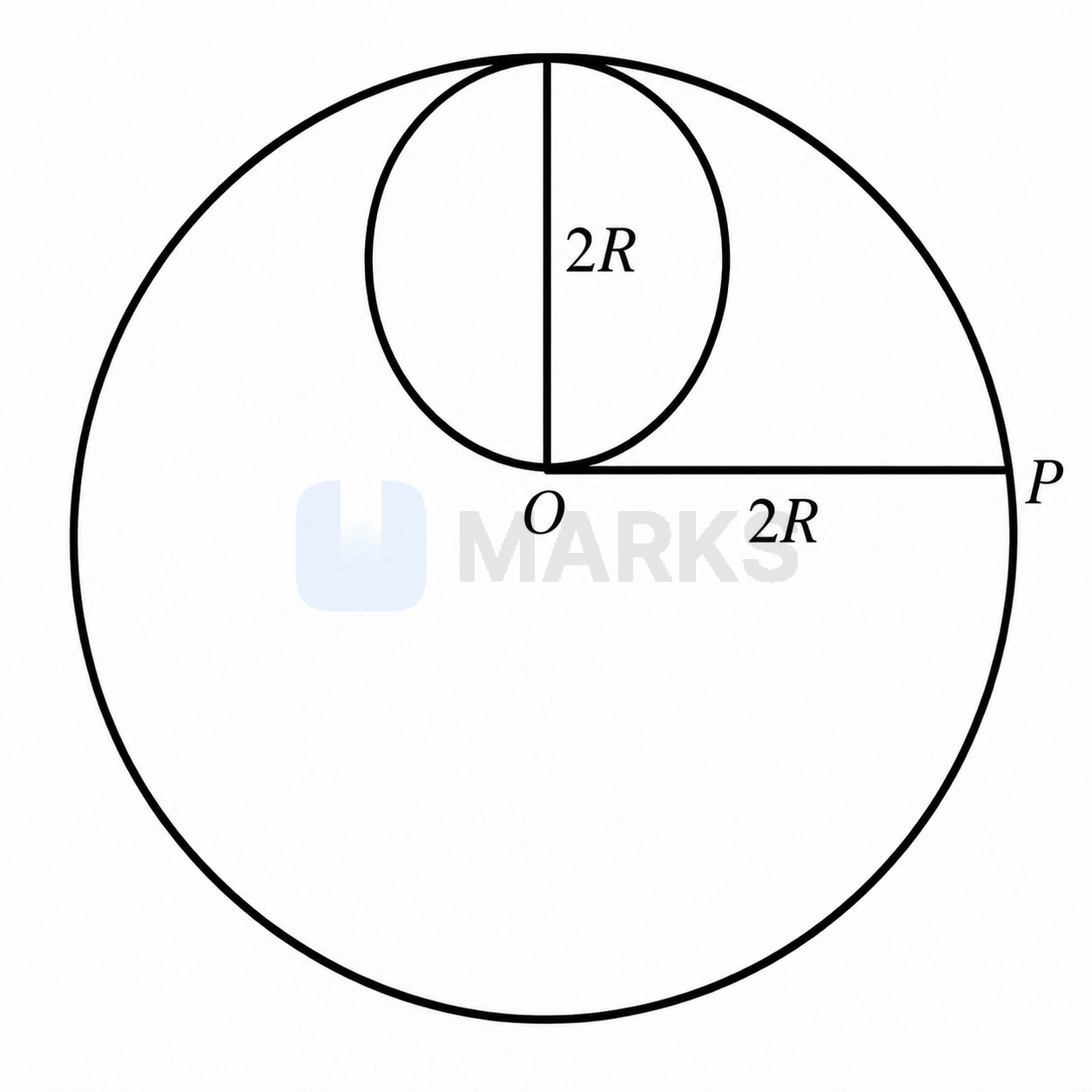
A very thin, uniform disc is made by removing a small disc of diameter $2R$ from a bigger (thin, uniform) disc of uniform mass density, mass $M$, and radius $2R$, as shown in the figure. The M.I. of this remaining part about an axis passing through point O and perpendicular to the plane of the figure is
- A$\dfrac{9MR^2}{8}$
- B$\dfrac{11MR^2}{9}$
- Correct answerC$\dfrac{13MR^2}{8}$
- D$\dfrac{15MR^2}{9}$
Solution
The mass of the original complete disc is $M$.
The radius of the original disc is $2R$.
The moment of inertia of the original disc about the axis passing through its center O and perpendicular to its plane is:
$I_{\text{original}} = \dfrac{1}{2} M (2R)^2 = 2MR^2$
The removed disc has a diameter of $2R$, which means its radius is $R$.
Since the disc is uniform, its mass is proportional to its area. The area of the original disc is $\pi(2R)^2 = 4\pi R^2$, and the area of the removed disc is $\pi R^2$.
Mass of the removed disc, $m = M \times \dfrac{\pi R^2}{4\pi R^2} = \dfrac{M}{4}$
The center of the removed disc is at a distance $R$ from O.
The moment of inertia of the removed disc about an axis passing through its own center of mass is:
$I_{\text{cm}} = \dfrac{1}{2} m R^2 = \dfrac{1}{2} \left(\dfrac{M}{4}\right) R^2 = \dfrac{MR^2}{8}$
Using the parallel axis theorem, the moment of inertia of the removed disc about the axis passing through O is:
$I_{\text{removed}} = I_{\text{cm}} + m d^2 = \dfrac{MR^2}{8} + \left(\dfrac{M}{4}\right) R^2 = \dfrac{3MR^2}{8}$
The moment of inertia of the remaining part about O is:
$I_{\text{remaining}} = I_{\text{original}} - I_{\text{removed}} = 2MR^2 - \dfrac{3MR^2}{8} = \dfrac{13MR^2}{8}$
Answer: $\dfrac{13MR^2}{8}$
Hence, the correct answer is option: 'C'.