Q166 / 200 · MHT CET - Medical 2026 (24 April Shift 1) · Physics
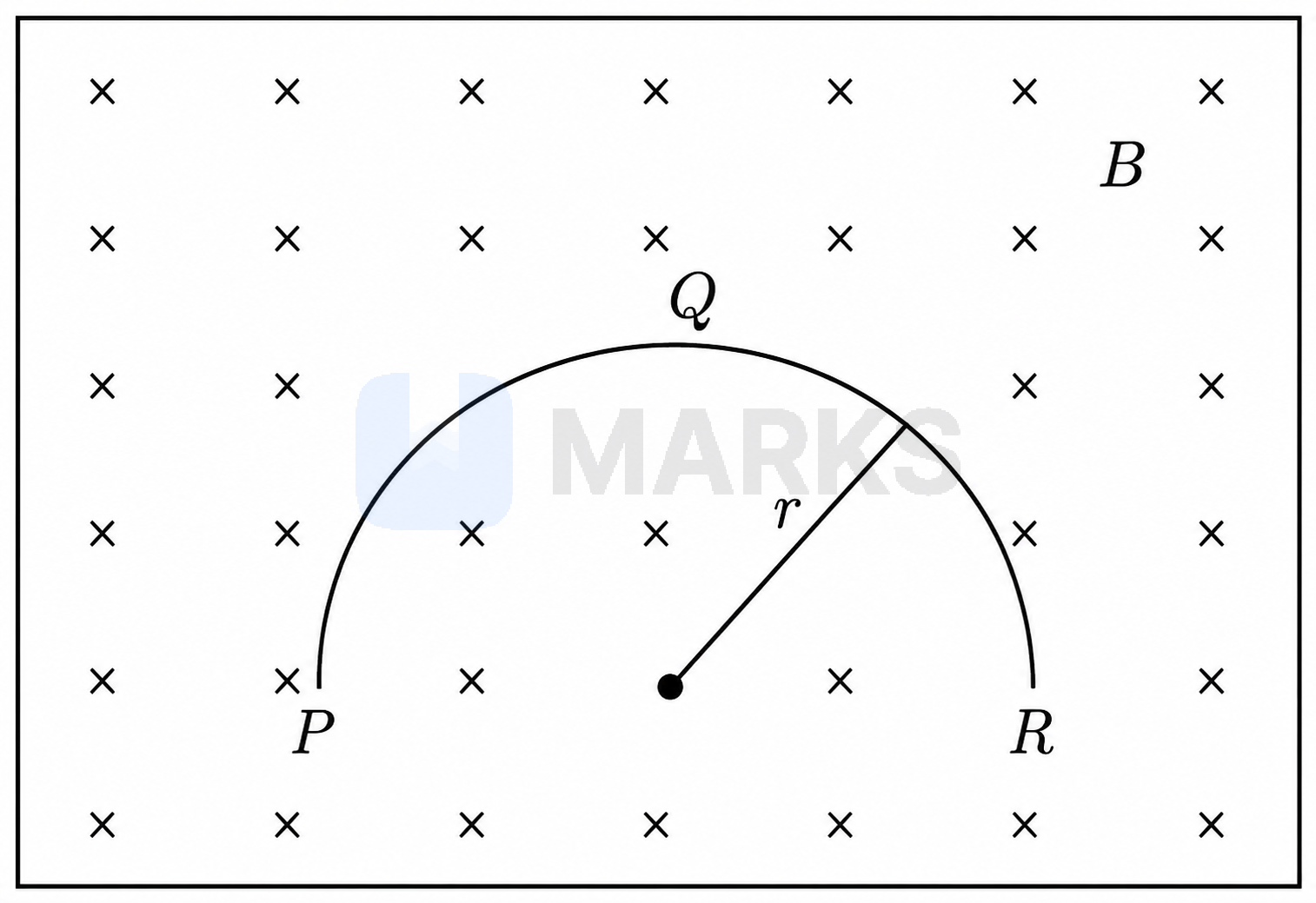
A thin semicircular conducting ring (PQR) of radius r is falling with its plane vertical in a horizontal magnetic field B as shown in the figure. The potential difference developed across the ring when its speed is v, is
$\{\sin(90)^\circ=1\}$
$\{\sin(90)^\circ=1\}$
- A$\pi rBv$ and terminal R is at higher potential
- B$\dfrac{Bv\pi r^{2}}{2}$ and terminal P is at higher potential
- Correct answerC$2rBv$ and terminal R is at higher potential
- Dzero
Solution
The motional emf induced in a conductor moving in a uniform magnetic field is given by $\varepsilon = (\vec{v} \times \vec{B}) \cdot \vec{l}$, where $\vec{l}$ is the vector connecting the ends of the conductor.
For the semicircular ring PQR, the effective length vector $\vec{l}$ is the straight line from P to R, which has a magnitude equal to the diameter of the semicircle.
$l_{\text{eff}} = 2r$
Since $\vec{v}$, $\vec{B}$, and $\vec{l}$ are mutually perpendicular, the magnitude of the induced motional emf is:
$\varepsilon = B v l_{\text{eff}} = 2rBv$
The polarity of the induced emf is determined by the direction of the magnetic force on the positive charges, given by $\vec{F} = q(\vec{v} \times \vec{B})$.
The velocity $\vec{v}$ is directed downwards and the magnetic field $\vec{B}$ is directed into the plane of the paper.
By the right-hand rule, the cross product $\vec{v} \times \vec{B}$ points towards the right.
This means positive charges are pushed towards terminal R, making it at a higher potential than terminal P.
Therefore, the potential difference developed across the ring is $2rBv$ with terminal R at a higher potential.
Answer: $2rBv$ and terminal R is at higher potential
Hence, the correct answer is option: 'C'.