Q115 / 155 · WBJEE 2024 · Mathematics
A square with each side equal to 'a' above the $x$-axis and has one vertex at the origin. One of the sides passing through the origin makes an angle $\alpha\left(0 \lt \alpha \lt \frac{\pi}{4}\right)$ with the positive direction of the axis. Equation of the diagonals of the square.
- Correct answerA$y(\cos \alpha-\sin \alpha)=x(\sin \alpha+\cos \alpha)$
- B$y(\cos \alpha+\sin \alpha)=x(\cos \alpha-\sin \alpha)$
- Correct answerC$y(\sin \alpha+\cos \alpha)+x(\cos \alpha-\sin \alpha)=a$
- D$y(\cos \alpha-\sin \alpha)+x(\cos \alpha+\sin \alpha)=a$
Solution
The parametric coordinate of one vertex of square is \((0+a \cos a, 0+a \sin a)\)
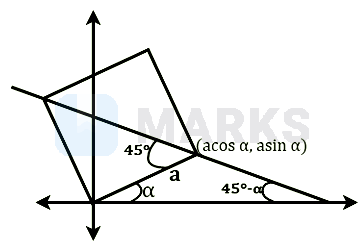 Inclination of diagonal not passing through origin is \(135^{\circ}+\mathrm{a}\) \(\therefore\) equation of the diagonal which is not passing through origin is
\(\begin{aligned}
& y-a \sin \alpha=\tan \left(135^{\circ}+\alpha\right)[x-a \cos \alpha] \\
& \Rightarrow y-a \sin a=-\tan \left(45^{\circ}-\alpha\right)[x-a \cos \alpha] \\
& \Rightarrow y-a \sin a=-\left(\frac{\cos a-\sin }{\sin \alpha+\cos \alpha}\right)[x-a \cos \alpha] \\
& \Rightarrow(y-a \sin \alpha)(\sin \alpha+\cos \alpha)+(\cos \alpha-\sin a)(x-a \cos \alpha)=0 \\
& \Rightarrow y(\sin a+\cos \alpha)+x(\cos \alpha-\sin \alpha)=a
\end{aligned}\)
Inclination of diagonal not passing through origin is \(135^{\circ}+\mathrm{a}\) \(\therefore\) equation of the diagonal which is not passing through origin is
\(\begin{aligned}
& y-a \sin \alpha=\tan \left(135^{\circ}+\alpha\right)[x-a \cos \alpha] \\
& \Rightarrow y-a \sin a=-\tan \left(45^{\circ}-\alpha\right)[x-a \cos \alpha] \\
& \Rightarrow y-a \sin a=-\left(\frac{\cos a-\sin }{\sin \alpha+\cos \alpha}\right)[x-a \cos \alpha] \\
& \Rightarrow(y-a \sin \alpha)(\sin \alpha+\cos \alpha)+(\cos \alpha-\sin a)(x-a \cos \alpha)=0 \\
& \Rightarrow y(\sin a+\cos \alpha)+x(\cos \alpha-\sin \alpha)=a
\end{aligned}\)Hence, the correct answer is options: 'A', 'C'.