Q149 / 160 · TS EAMCET 2018 (07 May Shift 1) · Physics
A square loop of length $L$ is placed with its edges parallel to the $X Y$-axes. The loop is carrying the current $I$. If the magnetic field in the region varies as $\mathbf{B}=B_0\left(1+\frac{X y}{L^2}\right) \hat{\mathbf{k}}$, then the magnitude of the force on the loop will be
- Correct answerA$1 5IB0l L$
- B$\frac{f B_0 L}{2}$
- C$\frac{B_0 L}{\sqrt{2}}$
- D$\sqrt{2}: B_0 L$
Solution
We take one vertex of square loop at origin,
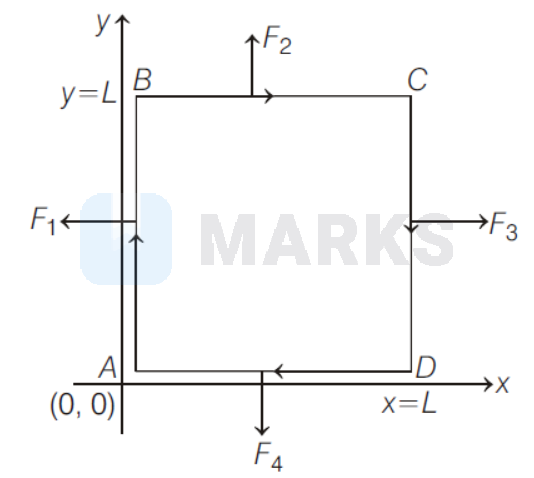
for wire $A B$, magnetic field $A B=B_0(1+0)=B_0$. $$ \therefore \quad n=0 $$ For wire $C D$, magnetic field $=B_0\left(1+\frac{y}{L}\right)$, $$ \therefore $$ $$ x=L $$ For wire $B C$, magnetic field $=B_0\left(1+\frac{\chi}{L}\right)$, $$ \therefore \quad y=L $$ and for wire $A D$, magnetic field $=B_0$ $$ \therefore \quad y=0 $$ Now me calculate forces $$ F_1, F_2, F_3 \text { and } F_4 \text {, } $$ $$ \begin{aligned} F_1 & =\int_0^L I B_0 \mathrm{dy}=I B_0 L \\ F_2 & =\int_0^L I B_0\left(1+\frac{x}{L}\right) d x \\ & =\frac{3}{2} I B_0 L \\ F_3 & =\int_0^I I B_0\left(1+\frac{y}{L}\right) d x \\ & =\frac{3}{2} I B_0 L \\ F_4 & =\int_0^L I B_0 d x=I B_0 L \end{aligned} $$
for wire $A B$, magnetic field $A B=B_0(1+0)=B_0$. $$ \therefore \quad n=0 $$ For wire $C D$, magnetic field $=B_0\left(1+\frac{y}{L}\right)$, $$ \therefore $$ $$ x=L $$ For wire $B C$, magnetic field $=B_0\left(1+\frac{\chi}{L}\right)$, $$ \therefore \quad y=L $$ and for wire $A D$, magnetic field $=B_0$ $$ \therefore \quad y=0 $$ Now me calculate forces $$ F_1, F_2, F_3 \text { and } F_4 \text {, } $$ $$ \begin{aligned} F_1 & =\int_0^L I B_0 \mathrm{dy}=I B_0 L \\ F_2 & =\int_0^L I B_0\left(1+\frac{x}{L}\right) d x \\ & =\frac{3}{2} I B_0 L \\ F_3 & =\int_0^I I B_0\left(1+\frac{y}{L}\right) d x \\ & =\frac{3}{2} I B_0 L \\ F_4 & =\int_0^L I B_0 d x=I B_0 L \end{aligned} $$
Hence, the correct answer is option: 'A'.