Q42 / 56 · IAT (IISER) 2026 · Physics
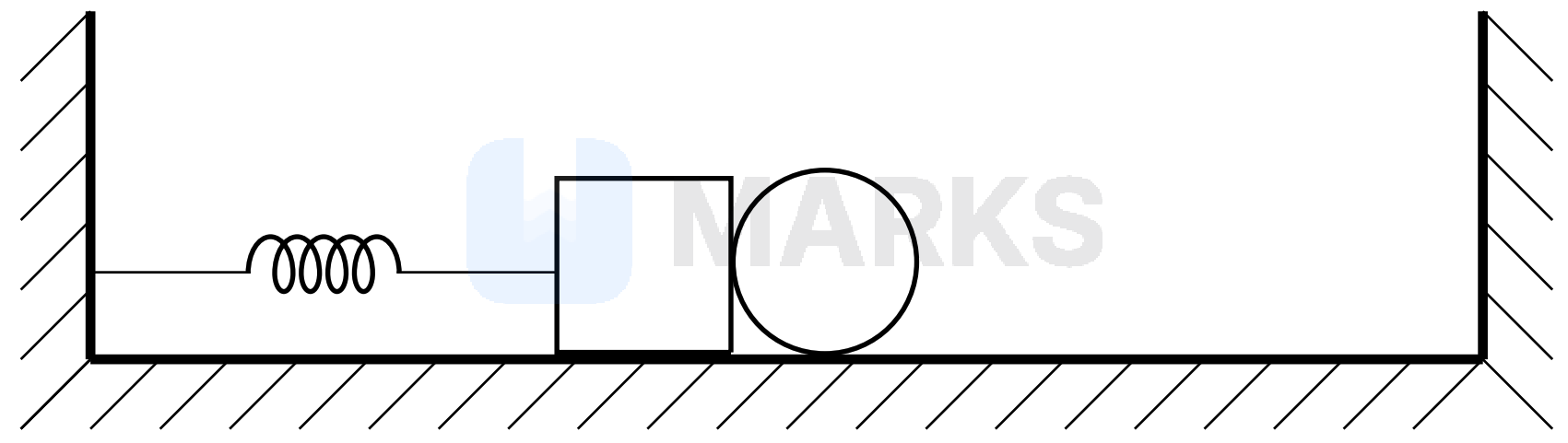
A sphere and a cube of equal masses on a horizontal frictionless floor, are confined between two vertical walls, as shown in the figure. The cube is attached to the wall by a massless spring. At the equilibrium position of the spring, the sphere just touches the cube. The cube is moved towards the left by a small amount $\ell$ from its equilibrium position, compressing the spring and is released at $t = 0$. The system keeps returning to its initial configuration as that of $t = 0$ with a time period $T$. If all the collisions are elastic, which of the following statements is correct?
- AIf $\ell$ increases, $T$ increases.
- BIf $\ell$ increases, $T$ does not change.
- CThe sphere never moves.
- Correct answerDIf $\ell$ increases, $T$ decreases.
Solution
Let the mass of the cube and the sphere be $m$. Let the spring constant be $k$.
When the cube is released from a compression $\ell$, it undergoes simple harmonic motion. It reaches the equilibrium position in time $t_1 = \dfrac{1}{4} \times 2\pi\sqrt{\dfrac{m}{k}} = \dfrac{\pi}{2}\sqrt{\dfrac{m}{k}}$.
At this position, the velocity of the cube is maximum, given by $v = \ell\omega = \ell\sqrt{\dfrac{k}{m}}$.
Since the sphere is at rest at the equilibrium position and has the same mass $m$, an elastic collision results in an exchange of velocities. The cube comes to rest, and the sphere acquires the velocity $v$.
The sphere then travels towards the right wall, covering a distance $D$ (the gap between the sphere and the right wall). It collides elastically with the wall and returns to its initial position. The time taken for this round trip is $t_2 = \dfrac{2D}{v} = \dfrac{2D}{\ell}\sqrt{\dfrac{m}{k}}$.
Upon returning, the sphere collides elastically with the stationary cube. They exchange velocities again. The sphere comes to rest, and the cube acquires a velocity $v$ towards the left.
The cube then compresses the spring and comes to rest at the initial position. The time taken for this is $t_3 = \dfrac{1}{4} \times 2\pi\sqrt{\dfrac{m}{k}} = \dfrac{\pi}{2}\sqrt{\dfrac{m}{k}}$.
The total time period of the system is $T = t_1 + t_2 + t_3$.
$T = \dfrac{\pi}{2}\sqrt{\dfrac{m}{k}} + \dfrac{2D}{\ell}\sqrt{\dfrac{m}{k}} + \dfrac{\pi}{2}\sqrt{\dfrac{m}{k}} = \pi\sqrt{\dfrac{m}{k}} + \dfrac{2D}{\ell}\sqrt{\dfrac{m}{k}}$.
From this expression, it is clear that as $\ell$ increases, the term $\dfrac{2D}{\ell}\sqrt{\dfrac{m}{k}}$ decreases. Therefore, the total time period $T$ decreases.
Answer: If $\ell$ increases, $T$ decreases.
Hence, the correct answer is option: 'D'.