Q130 / 180 · NEET 2026 (Re-NEET) · Physics
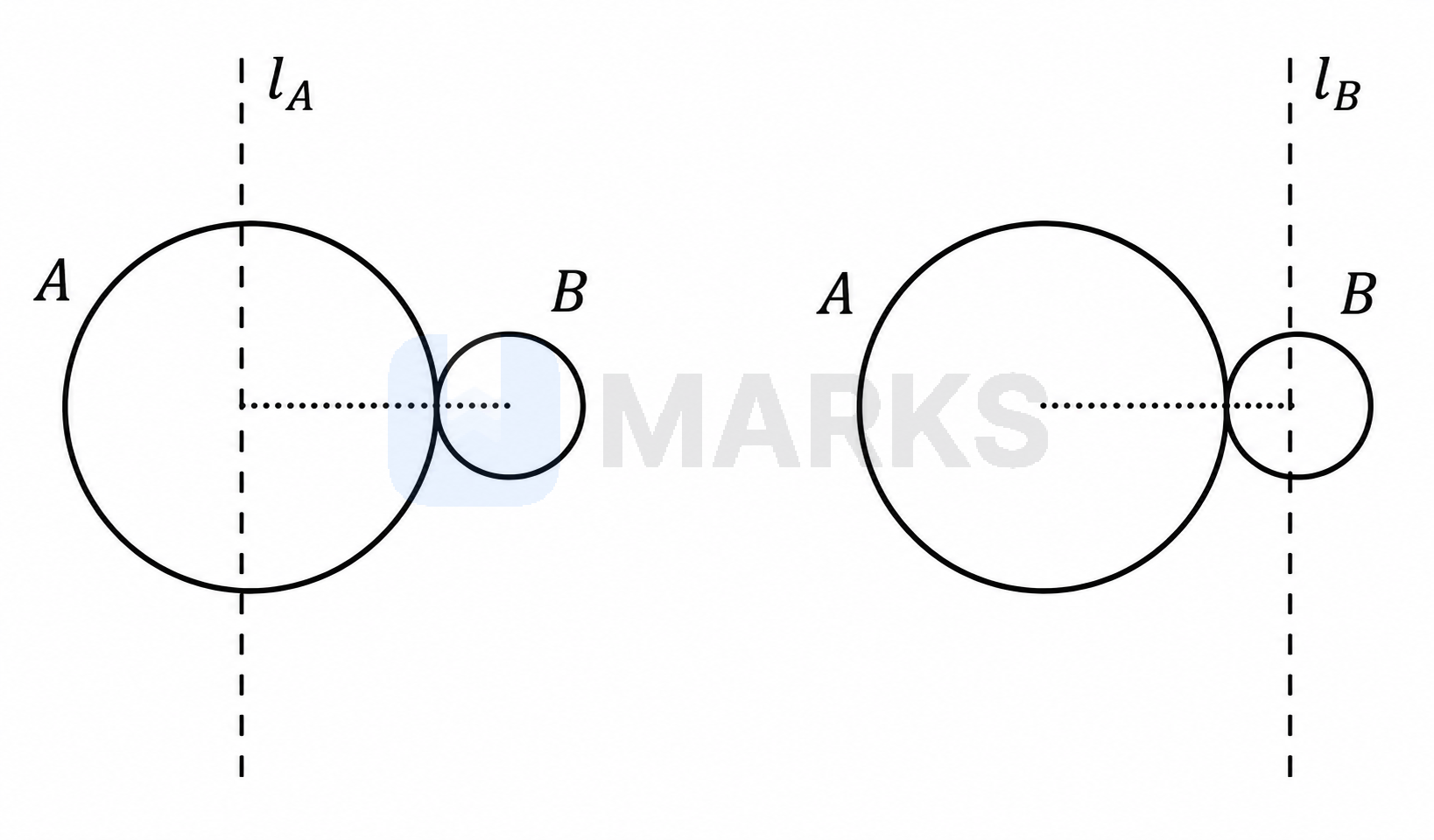
A solid sphere $A$ of radius $R$ and mass $M$ is attached at a point to a smaller solid sphere $B$ of radius $r < R$ and mass $m < M$. Assume that the line joining their centres lies along the horizontal. The moment of inertia of the system calculated about a vertical axis passing through the centre of $A$ is $I_A$ and that calculated about a vertical axis passing through the centre of $B$ is $I_B$. The difference $I_A-I_B$ is :
- A$0$
- B$(M-m)(R+r)^2$
- Correct answerC$(m-M)(R+r)^2$
- D$(m-M)(R-r)^2$
Solution
The distance between the centres of the two spheres $A$ and $B$ is $d = R + r$.
Let $I_{A,\text{cm}}$ and $I_{B,\text{cm}}$ be the moments of inertia of spheres $A$ and $B$ about their respective vertical centroidal axes. For solid spheres, $I_{A,\text{cm}} = \dfrac{2}{5}MR^2$ and $I_{B,\text{cm}} = \dfrac{2}{5}mr^2$.
The moment of inertia of the system about a vertical axis passing through the centre of $A$ is given by the sum of the moment of inertia of $A$ about its own centre and the moment of inertia of $B$ about the centre of $A$. Using the parallel axis theorem:
$I_A = I_{A,\text{cm}} + \left[ I_{B,\text{cm}} + m(R+r)^2 \right]$
Similarly, the moment of inertia of the system about a vertical axis passing through the centre of $B$ is:
$I_B = \left[ I_{A,\text{cm}} + M(R+r)^2 \right] + I_{B,\text{cm}}$
Now, finding the difference $I_A - I_B$:
$I_A - I_B = \left( I_{A,\text{cm}} + I_{B,\text{cm}} + m(R+r)^2 \right) - \left( I_{A,\text{cm}} + M(R+r)^2 + I_{B,\text{cm}} \right)$
$I_A - I_B = m(R+r)^2 - M(R+r)^2$
$I_A - I_B = (m - M)(R+r)^2$
Answer: $(m-M)(R+r)^2$
Hence, the correct answer is option: 'C'.