Q93 / 180 · AIIMS 2012 · Physics
A solid cylinder, a circular disc, a solid sphere and a hollow cylinder of the same radius are placed on an inclined plane. Which of the following will have maximum acceleration at the bottom of the plane?
- ACircular disc.
- BSolid cylinder.
- Correct answerCSolid sphere.
- DHollow cylinder.
Solution
Let the inclination of the inclined plane be $\theta$. Acceleration of a rolling body is given as
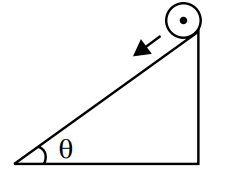
$a=\frac{g \sin \theta}{\left(1+K^2 / R^2\right)}$ Here, $K$ is radius of gyration. For circular disc $I=\frac{1}{2} M R^2 \quad \therefore \frac{K^2}{R^2}=\frac{1}{2}$ $\therefore \quad a=\frac{2}{3} g \sin \theta$
For solid cylinder $I=\frac{1}{2} M R^2 \therefore \frac{K^2}{R^2}=\frac{1}{2}$ $\therefore \quad a=\frac{2}{3} g \sin \theta$
For solid sphere $I=\frac{2}{5} M R^2 \therefore \frac{K^2}{R^2}=\frac{2}{5}$ $\therefore \quad a=\frac{5}{7} g \sin \theta$
For hollow cylinder $I=M R^2 \quad \therefore \frac{K^2}{R^2}=1$ $\therefore a=\frac{1}{2} g \sin \theta$
Hence, from (i), (ii), (iii) and (iv) we conclude that the solid sphere will reach the bottom with maximum acceleration.
Hence, the correct answer is option: 'C'.