Q103 / 150 · MHT CET 2025 (22 Apr Shift 2) · Physics
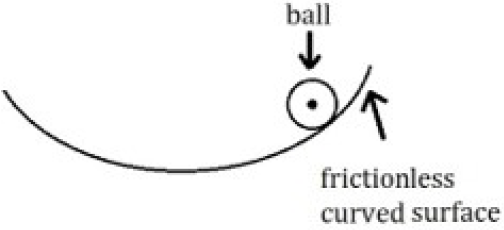
A small spherical ball of radius ' $r$ ' is rolling on a curved surface which is frictionless and has a radius of curvature ' R '. Its motion is simple harmonic. Then its time period of oscillation is proportional to ( $\mathrm{g}=$ acceleration due to gravity)
- A$\sqrt{\frac{R}{g}}$
- B$\sqrt{\frac{\mathrm{r}}{\mathrm{g}}}$
- Correct answerC$\sqrt{\frac{\mathrm{R}-\mathrm{r}}{\mathrm{g}}}$
- D$\sqrt{\frac{\mathrm{R}+\mathrm{r}}{\mathrm{g}}}$
Solution
The motion of the ball's center of mass along the frictionless curved surface is analogous to that of a simple pendulum.
Since the surface has radius of curvature $R$, the center of mass oscillates at a distance $L_{\text{eff}} = R - r$ from the center of curvature.
For small displacements, the time period is $T = 2\pi\sqrt{\frac{L_{\text{eff}}}{g}} = 2\pi\sqrt{\frac{R - r}{g}}$.
The time period is therefore proportional to $\sqrt{\frac{R - r}{g}}$.
Hence, the correct answer is option: 'C'.