Q127 / 160 · TS EAMCET 2018 (04 May Shift 2) · Physics
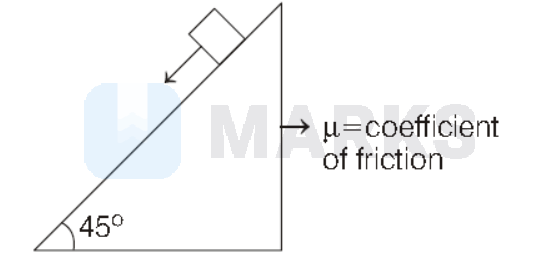
A small block starts sliding down an inclined plane forming an angle $45^{\circ}$ horizontal. The coefficient of friction $\mu$, varies with distance $s$ as $\mu=c s^2$ where, $c$ is a constant of appropriate dimensions, then distance covered by the block before it stops is
- Correct answerA$\sqrt{\frac{3}{C}}$
- B$\sqrt{3 C}$
- C$\sqrt{C}$
- D$\sqrt{\frac{1}{C}}$
Solution
$$
\text { Given that, }
$$
$\mu=C s^2 \quad\{\because s=$ distance and $C=$ constant $\}$ Net force on the block is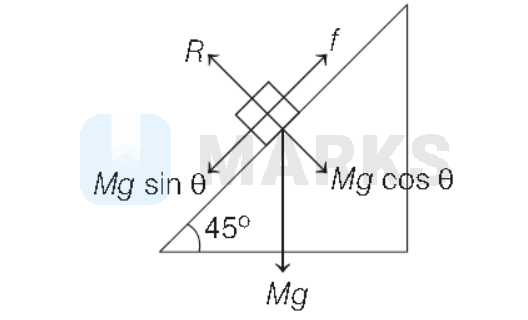
$$ \begin{gathered} M g \sin \theta-f=M a \\ M g \sin \theta-\mu M g \cos \theta=M a \\ g \sin \theta-\mu g \cos \theta=a \\ g\left[\sin \theta-C s^2 \cos \theta\right]=a \\ a=\frac{d v}{d t}=v \frac{d v}{d s} \\ \because \quad a d s=v d v \end{gathered} $$ From Eqs. (i) and (ii), we get $$ \Rightarrow \quad g\left[\sin \theta-C s^2 \cos \theta\right] d s=v d v $$ Integrating both sides, we get $$ \Rightarrow \quad(g \sin \theta) s-g \frac{C s^3}{3} \cos \theta=\frac{v^2}{2}+K $$ For $\theta=45^{\circ}$, we have, $$ \left(\frac{g}{\sqrt{2}}\right) s-\left(\frac{C s^3}{3}\right) \frac{g}{\sqrt{2}}=\frac{v^2}{2}+K $$ Initially $t=0, s=0, u=0$, substituting these, we get $k=0$ So, $$ \text { So, } \quad \begin{aligned} & \frac{g}{\sqrt{2}}\left(s-\frac{C s^3}{3}\right) & =\frac{v^2}{2} \\ \Rightarrow & s-\frac{C s^3}{3} & =\frac{v^2}{2} \times \frac{\sqrt{2}}{g} \end{aligned} $$ The body stops, when $v=0 \Rightarrow s-\frac{C s^3}{3}=0$ $$ \Rightarrow \quad s=\frac{C s^3}{3} \Rightarrow s=\sqrt{\frac{3}{C}} $$
$\mu=C s^2 \quad\{\because s=$ distance and $C=$ constant $\}$ Net force on the block is
$$ \begin{gathered} M g \sin \theta-f=M a \\ M g \sin \theta-\mu M g \cos \theta=M a \\ g \sin \theta-\mu g \cos \theta=a \\ g\left[\sin \theta-C s^2 \cos \theta\right]=a \\ a=\frac{d v}{d t}=v \frac{d v}{d s} \\ \because \quad a d s=v d v \end{gathered} $$ From Eqs. (i) and (ii), we get $$ \Rightarrow \quad g\left[\sin \theta-C s^2 \cos \theta\right] d s=v d v $$ Integrating both sides, we get $$ \Rightarrow \quad(g \sin \theta) s-g \frac{C s^3}{3} \cos \theta=\frac{v^2}{2}+K $$ For $\theta=45^{\circ}$, we have, $$ \left(\frac{g}{\sqrt{2}}\right) s-\left(\frac{C s^3}{3}\right) \frac{g}{\sqrt{2}}=\frac{v^2}{2}+K $$ Initially $t=0, s=0, u=0$, substituting these, we get $k=0$ So, $$ \text { So, } \quad \begin{aligned} & \frac{g}{\sqrt{2}}\left(s-\frac{C s^3}{3}\right) & =\frac{v^2}{2} \\ \Rightarrow & s-\frac{C s^3}{3} & =\frac{v^2}{2} \times \frac{\sqrt{2}}{g} \end{aligned} $$ The body stops, when $v=0 \Rightarrow s-\frac{C s^3}{3}=0$ $$ \Rightarrow \quad s=\frac{C s^3}{3} \Rightarrow s=\sqrt{\frac{3}{C}} $$
Hence, the correct answer is option: 'A'.