Q68 / 110 · VITEEE 2022 · Mathematics
\(A \operatorname{rod~} \mathrm{AB~} 13 \mathrm{ft}\) long moves with its ends \(\mathrm{A}, \mathrm{B}\) on two perpendicular lines \(\mathrm{OX}\) and \(\mathrm{OY}\) respectively. If the end \(\mathrm{A}\) is \(12 \mathrm{ft}\) from \(\mathrm{O}\) and is slipping away at \(2 \frac{1}{2} \mathrm{ft} / \mathrm{sec}\). then the end \(B\) is moving at
- A\(5 \mathrm{ft} / \mathrm{sec}\).
- Correct answerB\(6 \mathrm{ft} / \mathrm{sec}\).
- C\(2.5 \mathrm{ft} / \mathrm{sec}\).
- D\(3 \mathrm{ft} / \mathrm{sec}\).
Solution
At time t, let \(\mathrm{OA}=\mathrm{x}\) and \(\mathrm{OB}=\mathrm{y}\). Then \(\frac{\mathrm{dx}}{\mathrm{dt}}=2 \frac{1}{2} \mathrm{ft} / \mathrm{sec}\).
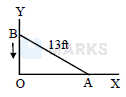
and we have to find \(\frac{\mathrm{dy}}{\mathrm{dt}}\). From right angled \(\triangle \mathrm{AOB}\), we have \(\mathrm{AB}^2=\mathrm{OA}^2+\mathrm{OB}^2\) \(13^2=\mathrm{x}^2+\mathrm{y}^2\) ...(1) Differentiating with respect to \(t\), we get \(\therefore \mathrm{x} \frac{\mathrm{dx}}{\mathrm{dt}}+\mathrm{y} \frac{\mathrm{dy}}{\mathrm{dt}}=0\) ...(2) When \(\mathrm{OA}=12\), i.e. \(\mathrm{x}=12\) then from (1), \(13^2=12^2+y^2\) or \(\mathrm{y}=\sqrt{13^2-12^2}=5\). Putting the values of \(y\) and \(\frac{\mathrm{dx}}{\mathrm{dt}}\) in (2), we get \(12 \times \frac{5}{2}+5 \times \frac{d y}{d t}=0\) or \(30+5 \frac{\mathrm{dy}}{\mathrm{dt}}=0 ; \quad \therefore \frac{\mathrm{dy}}{\mathrm{dt}}=-6 \mathrm{ft} / \mathrm{sec}\). Hence the end B is moving at the rate of \(6 \mathrm{ft} / \mathrm{sec}\). The negative sign shows the downward tendency of B i.e. y decreases when \(t\) increases)
and we have to find \(\frac{\mathrm{dy}}{\mathrm{dt}}\). From right angled \(\triangle \mathrm{AOB}\), we have \(\mathrm{AB}^2=\mathrm{OA}^2+\mathrm{OB}^2\) \(13^2=\mathrm{x}^2+\mathrm{y}^2\) ...(1) Differentiating with respect to \(t\), we get \(\therefore \mathrm{x} \frac{\mathrm{dx}}{\mathrm{dt}}+\mathrm{y} \frac{\mathrm{dy}}{\mathrm{dt}}=0\) ...(2) When \(\mathrm{OA}=12\), i.e. \(\mathrm{x}=12\) then from (1), \(13^2=12^2+y^2\) or \(\mathrm{y}=\sqrt{13^2-12^2}=5\). Putting the values of \(y\) and \(\frac{\mathrm{dx}}{\mathrm{dt}}\) in (2), we get \(12 \times \frac{5}{2}+5 \times \frac{d y}{d t}=0\) or \(30+5 \frac{\mathrm{dy}}{\mathrm{dt}}=0 ; \quad \therefore \frac{\mathrm{dy}}{\mathrm{dt}}=-6 \mathrm{ft} / \mathrm{sec}\). Hence the end B is moving at the rate of \(6 \mathrm{ft} / \mathrm{sec}\). The negative sign shows the downward tendency of B i.e. y decreases when \(t\) increases)
Hence, the correct answer is option: 'B'.