Q39 / 48 · JEE Advanced 2026 (Paper 1) · Physics
A quasi-static cycle of a monoatomic ideal gas contains an isothermal process $(\boldsymbol{ab})$, followed by an isochoric process $(\boldsymbol{bc})$ and an adiabatic process $(\boldsymbol{ca})$ as shown in the figure. The volumes of the gas are $V_1$ and $V_2$ at $\boldsymbol{a}$ and $\boldsymbol{b}$, respectively. If the cycle has heat input $Q_{\text{in}}$ and output $Q_{\text{out}}$, then the efficiency of the cycle is defined as $\eta = \dfrac{Q_{\text{in}} - Q_{\text{out}}}{Q_{\text{in}}}$. The correct statement(s) is/are:
[Given: $\ln 2 \approx 0.7$]
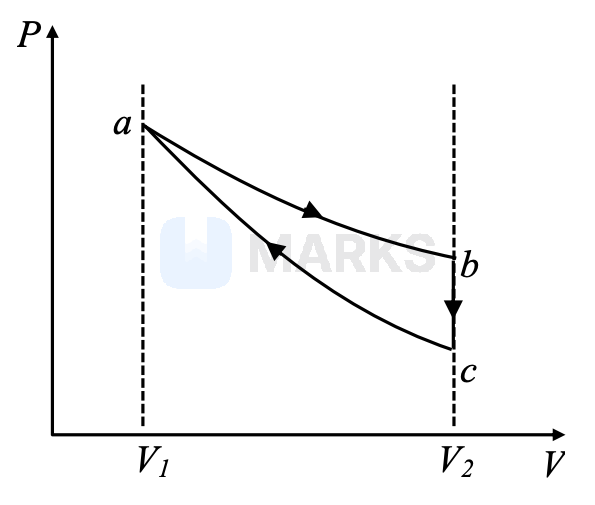
[Given: $\ln 2 \approx 0.7$]
- Correct answerAIf $V_2/V_1 = 8$, the heat released in the process $\boldsymbol{bc}$ is smaller than the heat absorbed in the process $\boldsymbol{ab}$.
- Correct answerBFor a given value of $V_2/V_1$, $\eta$ does not depend on the temperature of the isothermal process.
- Correct answerCIf $V_2/V_1 = 8$, then the temperature of the gas at $\boldsymbol{a}$ is $4$ times the temperature of the gas at $\boldsymbol{c}$.
- DIf $V_2/V_1 = 8$, then the pressure of the gas at $\boldsymbol{a}$ is $4$ times the pressure of the gas at $\boldsymbol{b}$.
Solution
For the monoatomic ideal gas, $\gamma = \dfrac{5}{3}$.
Process $ab$ is isothermal, so $T_a = T_b$ and $V_a = V_1$, $V_b = V_2$.
Process $bc$ is isochoric, so $V_b = V_c = V_2$.
Process $ca$ is adiabatic, so $T_c V_c^{\gamma-1} = T_a V_a^{\gamma-1}$.
$T_c V_2^{2/3} = T_a V_1^{2/3} \Rightarrow T_c = T_a \left(\dfrac{V_1}{V_2}\right)^{2/3}$.
If $\dfrac{V_2}{V_1} = 8$, $T_c = T_a \left(\dfrac{1}{8}\right)^{2/3} = \dfrac{T_a}{4} \Rightarrow T_a = 4 T_c$. Thus, statement (C) is correct.
Heat absorbed in isothermal process $ab$ is $Q_{ab} = nRT_a \ln\left(\dfrac{V_2}{V_1}\right)$.
For $\dfrac{V_2}{V_1} = 8$, $Q_{ab} = nRT_a \ln(8) = 3nRT_a \ln 2 \approx 3 \times 0.7 nRT_a = 2.1 nRT_a$.
Heat released in isochoric process $bc$ is $Q_{bc} = nC_v(T_b - T_c) = n\left(\dfrac{3}{2}R\right)\left(T_a - \dfrac{T_a}{4}\right) = \dfrac{9}{8}nRT_a = 1.125 nRT_a$.
Since $1.125 nRT_a < 2.1 nRT_a$, the heat released in $bc$ is smaller than the heat absorbed in $ab$. Thus, statement (A) is correct.
The efficiency of the cycle is $\eta = 1 - \dfrac{Q_{\text{out}}}{Q_{\text{in}}} = 1 - \dfrac{Q_{bc}}{Q_{ab}}$.
$\eta = 1 - \dfrac{n \left(\dfrac{3}{2} R\right) T_a \left(1 - \left(\dfrac{V_1}{V_2}\right)^{2/3}\right)}{nRT_a \ln\left(\dfrac{V_2}{V_1}\right)} = 1 - \dfrac{3 \left(1 - \left(\dfrac{V_1}{V_2}\right)^{2/3}\right)}{2 \ln\left(\dfrac{V_2}{V_1}\right)}$.
This expression depends only on the volume ratio $\dfrac{V_2}{V_1}$ and is independent of the temperature $T_a$. Thus, statement (B) is correct.
For the isothermal process $ab$, $P_a V_a = P_b V_b \Rightarrow P_a V_1 = P_b V_2 \Rightarrow P_a = 8 P_b$. Thus, statement (D) is incorrect.
Answer: If $V_2/V_1 = 8$, the heat released in the process $\boldsymbol{bc}$ is smaller than the heat absorbed in the process $\boldsymbol{ab}$.; For a given value of $V_2/V_1$, $\eta$ does not depend on the temperature of the isothermal process.; If $V_2/V_1 = 8$, then the temperature of the gas at $\boldsymbol{a}$ is $4$ times the temperature of the gas at $\boldsymbol{c}$.
Hence, the correct answer is options: 'A', 'B', 'C'.