Q73 / 75 · JEE Main 2026 (24 January Shift 2) · Physics
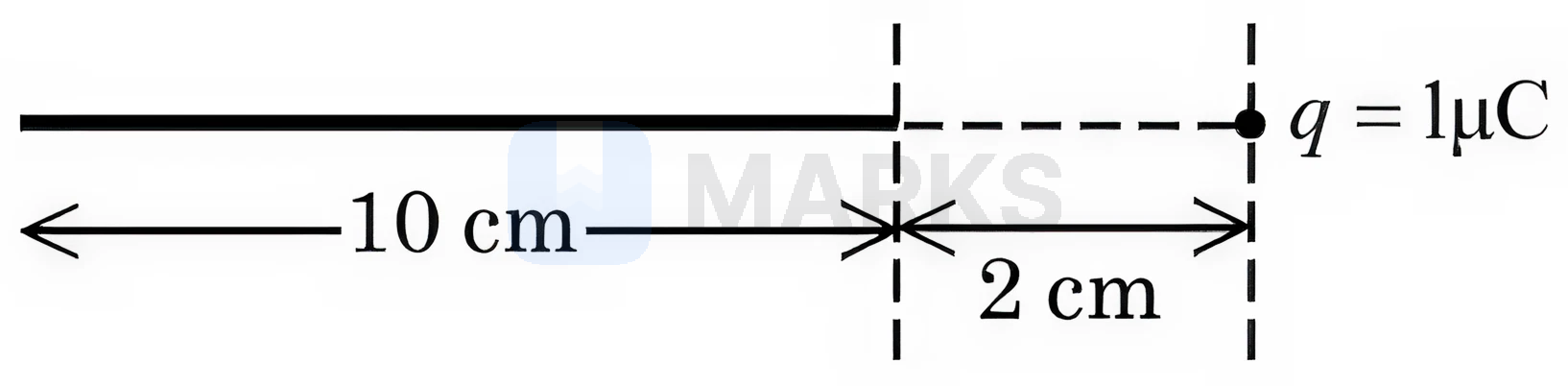
A point charge $q=1 \mu \mathrm{C}$ is located at a distance 2 cm from one end of a thin insulating wire of length 10 cm having a charge $Q=24 \mu \mathrm{C}$, distributed uniformly along its length, as shown in figure. Force between $q$ and wire is $\_\_\_\_$ N. (Use : $\frac{1}{4 \pi \epsilon_{\mathrm{o}}}=9 \times 10^{9} \mathrm{~N}. \mathrm{m}^{2} / \mathrm{C}^{2}$)
Correct answer: 90
Solution
Consider a small element of length $dx$ on the wire at a distance $x$ from the point charge $q$.
The linear charge density of the wire is $\lambda = \frac{Q}{L} = \frac{24 \times 10^{-6}}{0.1} = 240 \times 10^{-6}$ C/m.
The charge on the small element is $dQ = \lambda dx$.
The electrostatic force between the point charge $q$ and the element $dQ$ is $dF = \frac{k q dQ}{x^2} = \frac{k q \lambda dx}{x^2}$.
The total force $F$ is obtained by integrating $dF$ from $x = a$ to $x = a + L$, where $a = 2$ cm and $L = 10$ cm.
$F = \int_{0.02}^{0.12} \frac{k q \lambda}{x^2} dx = k q \lambda \left[ -\frac{1}{x} \right]_{0.02}^{0.12}$
$F = k q \lambda \left( \frac{1}{0.02} - \frac{1}{0.12} \right) = k q \frac{Q}{L} \left( \frac{0.12 - 0.02}{0.02 \times 0.12} \right)$
$F = \frac{k q Q}{L} \frac{L}{a(a+L)} = \frac{k q Q}{a(a+L)}$
Substituting the given values: $k = 9 \times 10^9$ N.m$^2$/C$^2$, $q = 1 \times 10^{-6}$ C, $Q = 24 \times 10^{-6}$ C, $a = 0.02$ m, and $a+L = 0.12$ m.
$F = \frac{9 \times 10^9 \times 1 \times 10^{-6} \times 24 \times 10^{-6}}{0.02 \times 0.12}$
$F = \frac{9 \times 24 \times 10^{-3}}{0.0024} = \frac{216 \times 10^{-3}}{2.4 \times 10^{-3}}$
$F = \frac{216}{2.4} = 90$ N.
Hence, the correct answer is 90.