Q149 / 155 · WBJEE 2026 · Physics
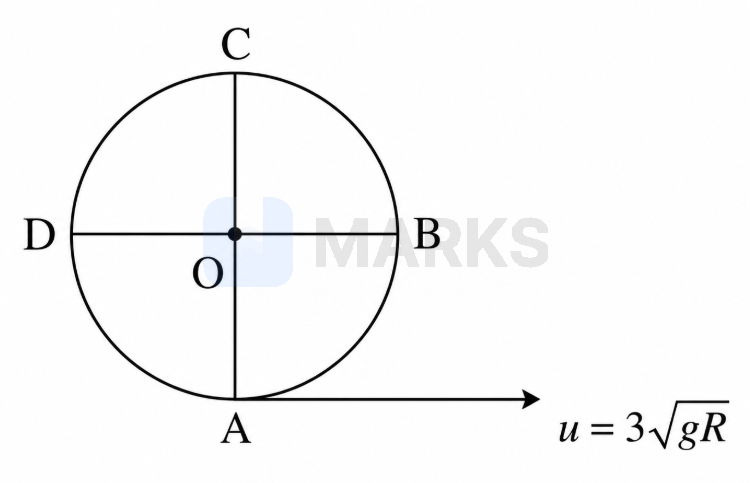
A particle of mass $m$ is suspended from a point $O$ by a string of length $R$. It is given a velocity $u = 3\sqrt{gR}$ at the bottom. The difference in tension at point $B$ and at the point $C$ is
- A$6$ mg
- B$4$ mg
- Correct answerC$3$ mg
- D$8$ mg
Solution
Velocity at the lowest point A is $u = 3\sqrt{gR}$.
By conservation of mechanical energy, the velocity $v$ at an angle $\theta$ from the lowest point is given by:
$\dfrac{1}{2}mu^2 = \dfrac{1}{2}mv^2 + mgR(1 - \cos\theta)$
$v^2 = u^2 - 2gR(1 - \cos\theta)$
The tension $T$ in the string at this position is:
$T - mg\cos\theta = \dfrac{mv^2}{R}$
$T = \dfrac{m}{R}[u^2 - 2gR(1 - \cos\theta)] + mg\cos\theta$
$T = \dfrac{mu^2}{R} - 2mg + 3mg\cos\theta$
Substituting $u^2 = 9gR$:
$T = 9mg - 2mg + 3mg\cos\theta = 7mg + 3mg\cos\theta$
At point B, the string is horizontal, so $\theta = 90^\circ$:
$T_B = 7mg + 3mg\cos 90^\circ = 7mg$
At point C, the particle is at the highest point, so $\theta = 180^\circ$:
$T_C = 7mg + 3mg\cos 180^\circ = 7mg - 3mg = 4mg$
The difference in tension at point B and point C is:
$T_B - T_C = 7mg - 4mg = 3mg$
Answer: $3$ mg
Hence, the correct answer is option: 'C'.