Q83 / 120 · VITEEE 2009 · Physics
A particle is projected up from a point at an angle $\theta$ with the horizontal direction. At any time $t$, if $p$ is the linear momentum, $y$ is the vertical displacement, $x$ is horizontal displacement, the graph among the following which does not represent the variation of kinetic energy KE of the particle is
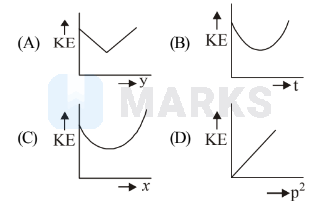
- Correct answerA$\operatorname{graph}(\mathrm{A})$
- Bgraph (B)
- C$\operatorname{graph}(\mathrm{C})$
- Dgraph (D)
Solution
Momentum, $p=m \cdot v \Rightarrow v=\left(\frac{p}{m}\right)$
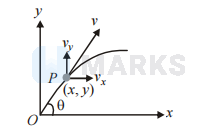
Kinetic energy, KE $$ \begin{array}{l} =\frac{1}{2} m v^{2}=\frac{1}{2} m\left(\frac{p^{2}}{m^{2}}\right)=\frac{1}{2 m} p^{2} \\ \text { or, } \mathrm{KE} \propto p^{2} \quad\left(\because \frac{1}{2 m}=\text { constant }\right) \end{array} $$ Hence, the graph between $\mathrm{KE}$ and $p^{2}$ will be linear. Now, kinetic energy $\mathrm{KE}=\frac{1}{2} m v^{2}$ The velocity component at point $P$, $v_{y}=(u \sin \theta-g t)$ and $v_{x}=u \cos \theta$ Resultant velocity at point $P$ $$ \begin{aligned} \vec{v} &=v_{y} \hat{j}+v_{x} \hat{i} \\ &=(u \sin \theta-g t) \hat{j}+u \cos \theta \hat{i} \\ &|\vec{v}|=\sqrt{(u \cos \theta)^{2}+(u \sin \theta-g t)^{2}} \\ =\sqrt{u^{2} \cos ^{2} \theta+u^{2} \sin ^{2} \theta+g^{2} t^{2}-2 u g t \sin \theta} \\ &=\sqrt{u^{2}\left(\cos ^{2} \theta+\sin ^{2} \theta\right)+g^{2} t^{2}-2 u g t \sin \theta} \end{aligned} $$ $$ \therefore \mathrm{KE}=\frac{1}{2} m\left(u^{2}+g^{2} t^{2}-2 u g t \sin \theta\right)ii/ $$ i. e., $\mathrm{KE} \propto t^{2}$ Hence, graph will be parabolic intercept on $y$-axis. Hence, the graph between $\mathrm{KE}$ and $t$. Now, in case of height $$ \begin{array}{l} \mathrm{KE}=\frac{1}{2} m\left(v^{2}\right) \text { and } v^{2}=\left(u^{2}-2 g y\right) \\ \therefore \mathrm{KE}=\frac{1}{2} m\left(u^{2}-2 g y\right) \\ \mathrm{KE}=-m g y+\frac{1}{2} m u^{2} \end{array} $$ Intercept on $y$-axis $=\frac{1}{2} m u^{2}$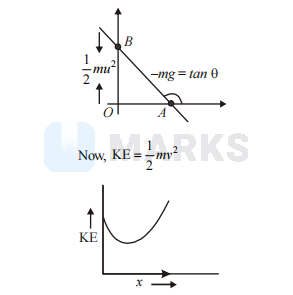
$$ \mathrm{KE}=\frac{1}{2} m\left(\frac{x}{t}\right)^{2} $$ i.e., $\mathrm{KE} \propto x^{2}$. Thus graph between $\mathrm{KE}$ and $x$ will be parabolic.
Kinetic energy, KE $$ \begin{array}{l} =\frac{1}{2} m v^{2}=\frac{1}{2} m\left(\frac{p^{2}}{m^{2}}\right)=\frac{1}{2 m} p^{2} \\ \text { or, } \mathrm{KE} \propto p^{2} \quad\left(\because \frac{1}{2 m}=\text { constant }\right) \end{array} $$ Hence, the graph between $\mathrm{KE}$ and $p^{2}$ will be linear. Now, kinetic energy $\mathrm{KE}=\frac{1}{2} m v^{2}$ The velocity component at point $P$, $v_{y}=(u \sin \theta-g t)$ and $v_{x}=u \cos \theta$ Resultant velocity at point $P$ $$ \begin{aligned} \vec{v} &=v_{y} \hat{j}+v_{x} \hat{i} \\ &=(u \sin \theta-g t) \hat{j}+u \cos \theta \hat{i} \\ &|\vec{v}|=\sqrt{(u \cos \theta)^{2}+(u \sin \theta-g t)^{2}} \\ =\sqrt{u^{2} \cos ^{2} \theta+u^{2} \sin ^{2} \theta+g^{2} t^{2}-2 u g t \sin \theta} \\ &=\sqrt{u^{2}\left(\cos ^{2} \theta+\sin ^{2} \theta\right)+g^{2} t^{2}-2 u g t \sin \theta} \end{aligned} $$ $$ \therefore \mathrm{KE}=\frac{1}{2} m\left(u^{2}+g^{2} t^{2}-2 u g t \sin \theta\right)ii/ $$ i. e., $\mathrm{KE} \propto t^{2}$ Hence, graph will be parabolic intercept on $y$-axis. Hence, the graph between $\mathrm{KE}$ and $t$. Now, in case of height $$ \begin{array}{l} \mathrm{KE}=\frac{1}{2} m\left(v^{2}\right) \text { and } v^{2}=\left(u^{2}-2 g y\right) \\ \therefore \mathrm{KE}=\frac{1}{2} m\left(u^{2}-2 g y\right) \\ \mathrm{KE}=-m g y+\frac{1}{2} m u^{2} \end{array} $$ Intercept on $y$-axis $=\frac{1}{2} m u^{2}$
$$ \mathrm{KE}=\frac{1}{2} m\left(\frac{x}{t}\right)^{2} $$ i.e., $\mathrm{KE} \propto x^{2}$. Thus graph between $\mathrm{KE}$ and $x$ will be parabolic.
Hence, the correct answer is option: 'A'.