Q113 / 180 · AIIMS 2017 · Physics
A particle is describing simple harmonic motion. If its velocities are $v_1$ and $v_2$ when the displacements from the mean position are $y_1$ and $y_2$ respectively, then its time period is
- A$2 \pi \sqrt{\frac{y_1^2+y_2^2}{v_1^2+v_2^2}}$
- B$2 \pi \sqrt{\frac{v_2^2-v_1^2}{y_1^2-y_2^2}}$
- C$2 \pi \sqrt{\frac{v_1^2+v_2^2}{y_1^2+y_2^2}}$
- Correct answerD$2 \pi \sqrt{\frac{y_1^2-y_2^2}{v_2^2-v_1^2}}$
Solution
In simple harmonic motion, velocity $v=\omega \sqrt{A^2-y^2}$
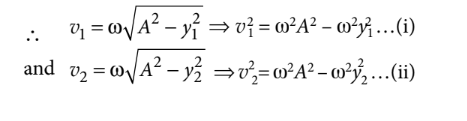
Solving equations (i) and (ii), we get $\begin{aligned} & v_2^2-v_1^2=\omega^2\left(y_1^2-y_2^2\right) \\ & \omega=\sqrt{\frac{v_2^2-v_1^2}{y_1^2-y_2^2}}\end{aligned}$ $\Rightarrow T=\frac{2 \pi}{\omega}=2 \pi \sqrt{\frac{y_1^2-y_2^2}{v_2^2-v_1^2}}$
Solving equations (i) and (ii), we get $\begin{aligned} & v_2^2-v_1^2=\omega^2\left(y_1^2-y_2^2\right) \\ & \omega=\sqrt{\frac{v_2^2-v_1^2}{y_1^2-y_2^2}}\end{aligned}$ $\Rightarrow T=\frac{2 \pi}{\omega}=2 \pi \sqrt{\frac{y_1^2-y_2^2}{v_2^2-v_1^2}}$
Hence, the correct answer is option: 'D'.