Q94 / 160 · TS EAMCET 2017 · Mathematics
A parallelogram has vertices $A(4,4,-1), B(5,6,-1), C(6,5,1)$ and $D(x, y, z)$. Then the vertex $D$ is
- A$(5,1,0)$
- B$(-5,0,1)$
- Correct answerC$(5,3,1)$
- D$(5,1,3)$
Solution
Given, $A B C D$ is a parallelogram with vertices $A(4,4,-1), B(5,6,-1), C(6,5,1)$ and $D(x, y, z)$.
We know that diagonals of parallelogram $A B C D$ bisects each other.
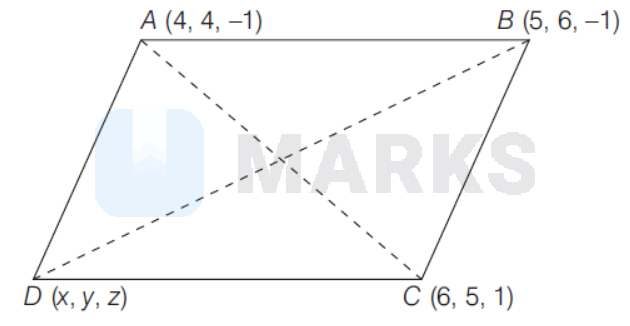
$\therefore$ Mid-point of $A C=$ Mid-Point of $B D$ $$ \begin{array}{ll} \Rightarrow\left(\frac{4+6}{2}, \frac{4+5}{2}, \frac{-1+1}{2}\right)=\left(\frac{x+5}{2}, \frac{y+6}{2}, \frac{z-1}{2}\right) \\ \Rightarrow \quad & \left(\frac{10}{2}, \frac{9}{2}, 0\right)=\left(\frac{x+5}{2}, \frac{y+6}{2}, \frac{z-1}{2}\right) \end{array} $$ On comparing both sides, we get $$ \begin{array}{rlrl} & & \frac{x+5}{2}=\frac{10}{2}, \frac{y+6}{2} & =\frac{9}{2} \text { and } \frac{z-1}{2}=0 \\ \Rightarrow & x+5=10, y+6 & =9 \text { and } z-1=0 \\ \Rightarrow & x=10-5, y & =9-6 \text { and } z=1 \\ \Rightarrow & & x=5, y & =3 \text { and } z=1 \\ & \text { Thus, } & D(x, y, z) & =D(5,3,1) \end{array} $$
$\therefore$ Mid-point of $A C=$ Mid-Point of $B D$ $$ \begin{array}{ll} \Rightarrow\left(\frac{4+6}{2}, \frac{4+5}{2}, \frac{-1+1}{2}\right)=\left(\frac{x+5}{2}, \frac{y+6}{2}, \frac{z-1}{2}\right) \\ \Rightarrow \quad & \left(\frac{10}{2}, \frac{9}{2}, 0\right)=\left(\frac{x+5}{2}, \frac{y+6}{2}, \frac{z-1}{2}\right) \end{array} $$ On comparing both sides, we get $$ \begin{array}{rlrl} & & \frac{x+5}{2}=\frac{10}{2}, \frac{y+6}{2} & =\frac{9}{2} \text { and } \frac{z-1}{2}=0 \\ \Rightarrow & x+5=10, y+6 & =9 \text { and } z-1=0 \\ \Rightarrow & x=10-5, y & =9-6 \text { and } z=1 \\ \Rightarrow & & x=5, y & =3 \text { and } z=1 \\ & \text { Thus, } & D(x, y, z) & =D(5,3,1) \end{array} $$
Hence, the correct answer is option: 'C'.