Q207 / 270 · NDA 2021 (Phase 1) · Mathematics
A parallelogram has three consecutive vertices $(-3,4)$, $(0,-4)$ and $(5,2)$. The fourth vertex is
- Correct answerA$(2,10)$
- B$(2,9)$
- C$(3,9)$
- D$(4,10)$
Solution
Let $A B C D$ is a parallelogram as shown in figure.
Point $O$ is the point of intersection of two diagonals.
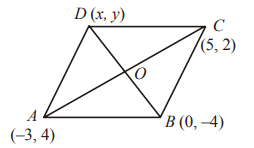
Point ' $O$ ' $=\left(\frac{-3+5}{2}, \frac{4+2}{2}\right)=(1,3)$. Now, point ' $O$ ' bisect diagonal $B D$. $\begin{aligned} & 1=\frac{x+0}{2} \Rightarrow x=2 \\ & 3=\frac{y-4}{2} \Rightarrow y=10 .\end{aligned}$ $\therefore$ Fourth vertices $D(x, y)=(2,10)$.
Point ' $O$ ' $=\left(\frac{-3+5}{2}, \frac{4+2}{2}\right)=(1,3)$. Now, point ' $O$ ' bisect diagonal $B D$. $\begin{aligned} & 1=\frac{x+0}{2} \Rightarrow x=2 \\ & 3=\frac{y-4}{2} \Rightarrow y=10 .\end{aligned}$ $\therefore$ Fourth vertices $D(x, y)=(2,10)$.
Hence, the correct answer is option: 'A'.