Q34 / 75 · JEE Main 2025 (3 Apr Shift 1) · Mathematics
A line passing through the point $\mathrm{P}(\sqrt{5}, \sqrt{5})$ intersects the ellipse $\frac{\mathrm{x}^2}{36}+\frac{\mathrm{y}^2}{25}=1$ at $A$ and $B$ such that $(P A) .(P B)$ is maximum. Then $5\left(P A^2+P B^2\right)$ is equal to :
- A$218$
- B$377$
- C$290$
- Correct answerD$338$
Solution
Given ellipse is $\frac{x^2}{36}+\frac{y^2}{25}=1$
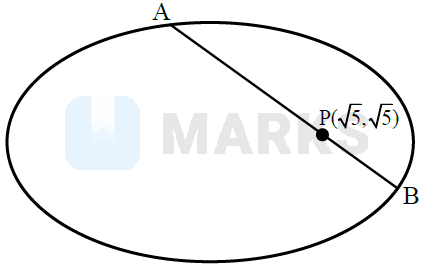
Any point on line $A B$ can be assumed as
$\mathrm{Q}(\sqrt{5}+\mathrm{r} \cos \theta, \sqrt{5}+\mathrm{r} \sin \theta)$
Putting this in equation of ellipse, we get
$25(\sqrt{5}+r \cos \theta)^2+36(\sqrt{5}+r \sin \theta)^2=900$
Simplifying, we get
$\begin{aligned}<br/>& \mathrm{r}^2\left(25 \cos ^2 \theta+36 \sin ^2 \theta\right)+2 \sqrt{5} \mathrm{r}(25 \cos \theta+36 \sin \theta)-595=0 \\ & \quad|\mathrm{r}|=\mathrm{PA}, \mathrm{~PB}<br/>\end{aligned}$
$\text { Thus, } \begin{aligned}<br/>\text { PA } \cdot \mathrm{PB} & =\frac{595}{25 \cos ^2 \theta+36 \sin ^2 \theta}=\frac{595}{25+11 \sin ^2 \theta} \\ & =\text { maximum, if } \sin ^2 \theta=0<br/>\end{aligned}$
This means line $A B$ must be parallel to $x$-axis
$\Rightarrow y_A=y_B=\sqrt{5}$
Putting $\mathrm{y}=\sqrt{5}$ in equation of ellipse, we get
$\frac{x^2}{36}+\frac{1}{5}=1 \Rightarrow x^2=36 \cdot \frac{4}{5}$
Hence,
$\mathrm{PA}^2+\mathrm{PB}^2=\left(\sqrt{5}-\frac{12}{\sqrt{5}}\right)^2+\left(\sqrt{5}+\frac{12}{\sqrt{5}}\right)^2$
$\begin{aligned} & =2\left(5+\frac{144}{5}\right)=\frac{338}{5} \\ & 5\left(\mathrm{PA}^2+\mathrm{PB}^2\right)=338\end{aligned}$
Hence, the correct answer is option: 'D'.