Q14 / 180 · KCET 2021 · Chemistry
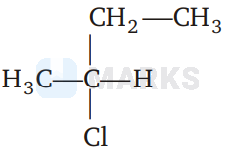
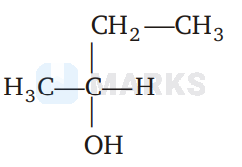
A hydrocarbon $A\left(\mathrm{C}_{4} \mathrm{H}_{8}\right)$ on reaction with $\mathrm{HCl}$ gives a compound $B\left(\mathrm{C}_{4} \mathrm{H}_{9} \mathrm{Cl}\right)$ which on reaction with $1 \mathrm{~mol}$ of $\mathrm{NH}_{3}$ gives compound $C\left(\mathrm{C}_{4} \mathrm{H}_{10} \mathrm{~N}\right)$. On reacting with $\mathrm{NaNO}_{2}$ and $\mathrm{HCl}$ followed by treatment with water, compound $C$ yields an optically active compound $D$. The compound $D$ is
- A
- Correct answerB
- C
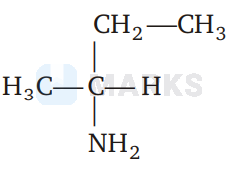
- D
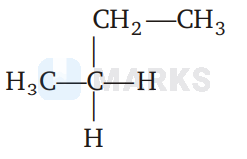
Solution
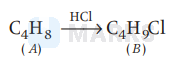
From the given information question, addition of $\mathrm{HCl}$ occured on $A$. That means $A$ is an alkene.
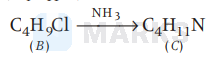
$\mathrm{Cl}$ in compound $B$ is substituted by $\mathrm{NH}_{2}$ to give compound $C\left(\mathrm{C}_{4} \mathrm{H}_{11} \mathrm{~N}\right)$.
$C$ gives a diazonium salt with $\mathrm{NaNO}_{2} / \mathrm{HCl}$ which on further treatment with water give an optically active alcohol. That means $C$ is an aliphatic amine.

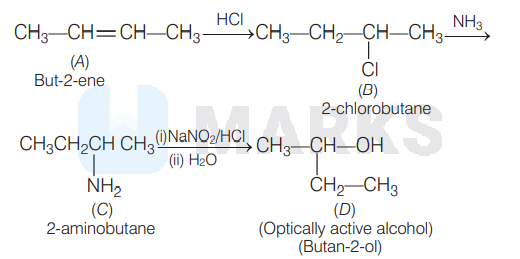
From the given information it is concluded that the most probable structure of $A$ is $\mathrm{CH}_{3}-\mathrm{CH}=\mathrm{CH}-\mathrm{CH}_{3}$. As only but-2-ene gives optically active alcohol $(D)$ as final product. The reactions involves are as follows.
$\mathrm{Cl}$ in compound $B$ is substituted by $\mathrm{NH}_{2}$ to give compound $C\left(\mathrm{C}_{4} \mathrm{H}_{11} \mathrm{~N}\right)$.
$C$ gives a diazonium salt with $\mathrm{NaNO}_{2} / \mathrm{HCl}$ which on further treatment with water give an optically active alcohol. That means $C$ is an aliphatic amine.
From the given information it is concluded that the most probable structure of $A$ is $\mathrm{CH}_{3}-\mathrm{CH}=\mathrm{CH}-\mathrm{CH}_{3}$. As only but-2-ene gives optically active alcohol $(D)$ as final product. The reactions involves are as follows.
Hence, the correct answer is option: 'B'.