Q123 / 180 · AIIMS 2005 · Physics
A given shaped glass tube having uniform cross section is filled with water and is mounted on a rotatable shaft as shown in figure. If the tube is rotated with a constant angular velocity $\omega$ when
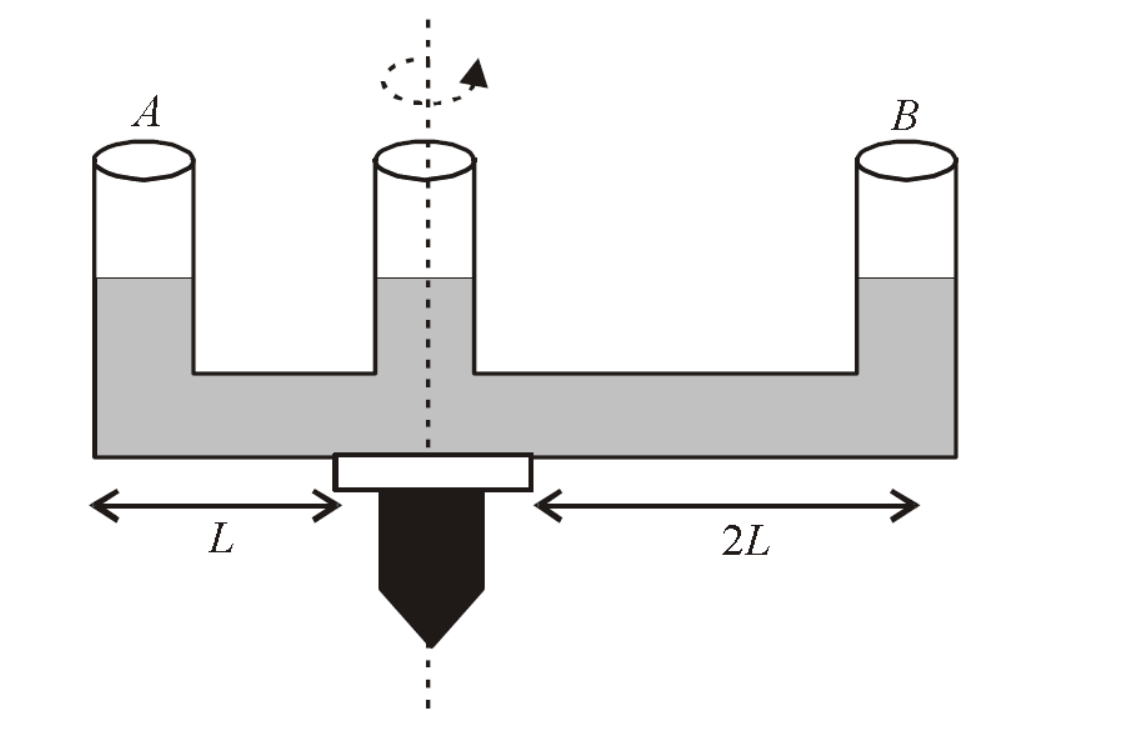
- Correct answerAwater levels in both sections $A$ and $B$ go up
- Bwater level in section $A$ goes up and that in $B$ comes down
- Cwater level in section $A$ comes down and that in $B$ it goes up
- Dwater levels remain same in both sections.
Solution
Due to rotation about the axis $O O^{\prime}$, a force is acting on the liquid column $A B$ outwards, pushing up the liquid column on the right. This centrifugal force acting on the small element $d x$ of area of cross-section $d x$, distant $x$ from the axis is
$$
d m \omega^2 x=A d x \rho \omega^2 x
$$
The total force due to column of length $L(=A B)$ is
$$
\int_0^L A \rho \omega^2 \cdot x d x=A \rho \omega^2 \frac{L^2}{2}
$$
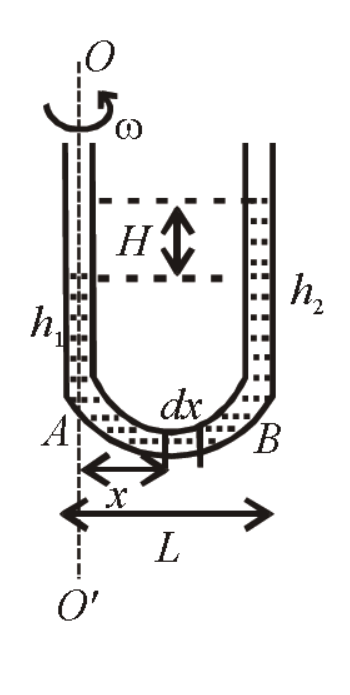
Pressure at $B=$ atmospheric pressure + $$ h_1 \rho g+\frac{A \rho \omega^2}{A} \frac{L^2}{2} $$ Pressure at $B$ due to liquid column on the right hand side $=$ atmospheric pressure $+h_2 \rho g$ Net pressure due to the left hand side $=$ pressure at $B$ due to liquid column $$ \begin{aligned} & \quad \text { atm. pressure }+h_1 \rho g+\rho \omega^2 \frac{L^2}{2}=\text { atm. pressure }+h_2 \rho g \\ & \therefore \quad h_2-h_1=H_0=\frac{\omega^2 L^2}{2 g} . \end{aligned} $$ $$ \text { Here one has } $$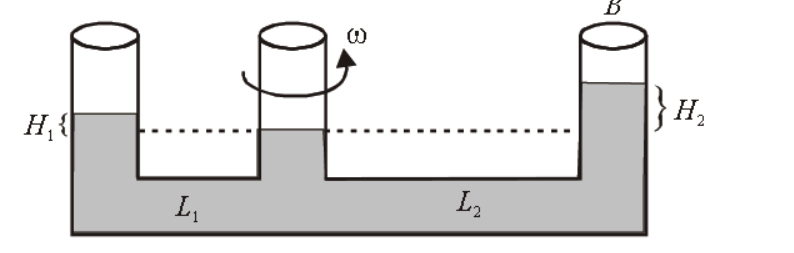
$$ H_2=\frac{\omega^2 L_2^2}{2 g}, \quad H_1=\frac{\omega^2 L_1^2}{2 g} $$ As $\omega$ is the same, and $L_2>L_1, H_2>H_1$. But both will go up.
Pressure at $B=$ atmospheric pressure + $$ h_1 \rho g+\frac{A \rho \omega^2}{A} \frac{L^2}{2} $$ Pressure at $B$ due to liquid column on the right hand side $=$ atmospheric pressure $+h_2 \rho g$ Net pressure due to the left hand side $=$ pressure at $B$ due to liquid column $$ \begin{aligned} & \quad \text { atm. pressure }+h_1 \rho g+\rho \omega^2 \frac{L^2}{2}=\text { atm. pressure }+h_2 \rho g \\ & \therefore \quad h_2-h_1=H_0=\frac{\omega^2 L^2}{2 g} . \end{aligned} $$ $$ \text { Here one has } $$
$$ H_2=\frac{\omega^2 L_2^2}{2 g}, \quad H_1=\frac{\omega^2 L_1^2}{2 g} $$ As $\omega$ is the same, and $L_2>L_1, H_2>H_1$. But both will go up.
Hence, the correct answer is option: 'A'.