Q161 / 200 · MHT CET - Medical 2026 (25 April Shift 1) · Physics
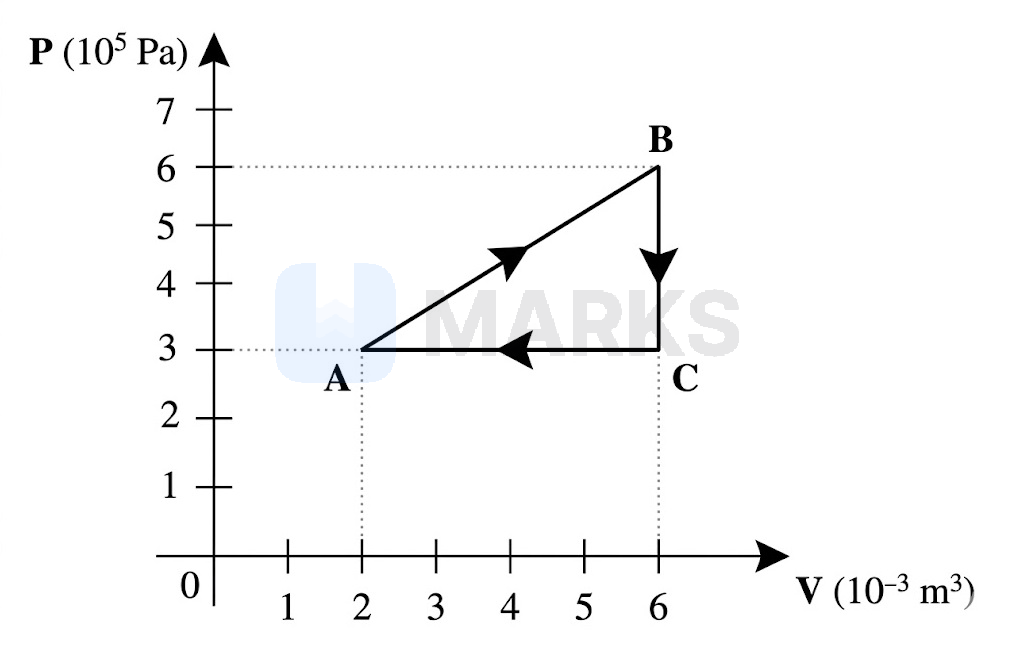
A gas is taken through a cycle $A \rightarrow B \rightarrow C \rightarrow A$, as shown in the figure. The net work done by the gas is
- Correct answerA$600\ \text{J}$
- B$1200\ \text{J}$
- C$1800\ \text{J}$
- D$400\ \text{J}$
Solution
The net work done by the gas in a cyclic process is equal to the area enclosed by the cycle on the P-V diagram.
From the given graph, the cycle $A \rightarrow B \rightarrow C \rightarrow A$ forms a right-angled triangle.
The base of the triangle is $\Delta V = (6 - 2) \times 10^{-3}\ \text{m}^3 = 4 \times 10^{-3}\ \text{m}^3$.
The height of the triangle is $\Delta P = (6 - 3) \times 10^5\ \text{Pa} = 3 \times 10^5\ \text{Pa}$.
Since the cycle is clockwise, the net work done is positive.
$\text{Net work done } (W) = \text{Area of } \triangle ABC$
$W = \dfrac{1}{2} \times \text{base} \times \text{height}$
$W = \dfrac{1}{2} \times (4 \times 10^{-3}\ \text{m}^3) \times (3 \times 10^5\ \text{Pa})$
$W = \dfrac{1}{2} \times 12 \times 10^2\ \text{J}$
$W = 600\ \text{J}$
Answer: $600\ \text{J}$
Hence, the correct answer is option: 'A'.