Q168 / 180 · COMEDK 2023 (Memory Based) · Physics
A galvanometer having a resistance of $8 \Omega$ is shunted by a wire of resistance $2 \Omega$. If the total current is $1 \mathrm{~A}$, the part of it passing through the shunt will be
- A$0.25 \mathrm{~A}$
- Correct answerB$0.8 \mathrm{~A}$
- C$0.2 \mathrm{~A}$
- D$0.5 \mathrm{~A}$
Solution
Let total current through the parallel combination be $I$, the current through the galvanometer be $I_g$ and the current through the shunt be $I-I_g$.
The shunted galvanometer is shown in the figure.
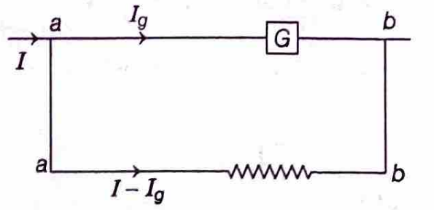
The potential difference, $V_{a b}=\left(V_a-V_b\right)$ is the same for both paths, so $I_g G=\left(I-I_g\right) S$ $\Rightarrow I_g(G+S)=I S \Rightarrow \frac{I_g}{I}=\frac{S}{S+G}$ The fraction of current passing through shunt $\begin{aligned} & =\frac{I-I_g}{I}=1-\frac{I_g}{I}=1-\frac{S}{S+G}=\frac{G}{S+G} \\ & =\frac{8}{2+8}=\frac{8}{10}=0.8 \mathrm{~A} \end{aligned}$
The potential difference, $V_{a b}=\left(V_a-V_b\right)$ is the same for both paths, so $I_g G=\left(I-I_g\right) S$ $\Rightarrow I_g(G+S)=I S \Rightarrow \frac{I_g}{I}=\frac{S}{S+G}$ The fraction of current passing through shunt $\begin{aligned} & =\frac{I-I_g}{I}=1-\frac{I_g}{I}=1-\frac{S}{S+G}=\frac{G}{S+G} \\ & =\frac{8}{2+8}=\frac{8}{10}=0.8 \mathrm{~A} \end{aligned}$
Hence, the correct answer is option: 'B'.