Q36 / 48 · JEE Advanced 2026 (Paper 1) · Physics
A double convex lens made of glass of refractive index $1.5$ and radii of curvature of the curved surfaces $20$ cm each is immersed in a liquid of refractive index $n_L$. The correct plot showing the variation of the power, in the units of diopter $(D)$, as a function of $n_L$ is:
- Correct answerA
- B
- C
- D
Solution
The focal length $f$ of a lens immersed in a medium of refractive index $n_L$ is given by the Lens Maker's formula:
$\dfrac{1}{f} = \left( \dfrac{n_g}{n_L} - 1 \right) \left( \dfrac{1}{R_1} - \dfrac{1}{R_2} \right)$
Given that the lens is double convex, the radii of curvature are $R_1 = +20 \text{ cm} = +0.2 \text{ m}$ and $R_2 = -20 \text{ cm} = -0.2 \text{ m}$. The refractive index of the glass is $n_g = 1.5$.
Substituting these values into the formula gives:
$\dfrac{1}{f} = \left( \dfrac{1.5}{n_L} - 1 \right) \left( \dfrac{1}{0.2} - \dfrac{1}{-0.2} \right)$
$\dfrac{1}{f} = \left( \dfrac{1.5}{n_L} - 1 \right) (5 + 5) = 10 \left( \dfrac{1.5}{n_L} - 1 \right)$
The power $P$ of the lens is defined as the reciprocal of its focal length in meters:
$P = \dfrac{1}{f} = \dfrac{15}{n_L} - 10$
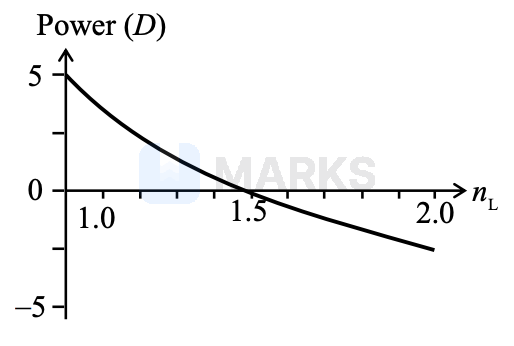
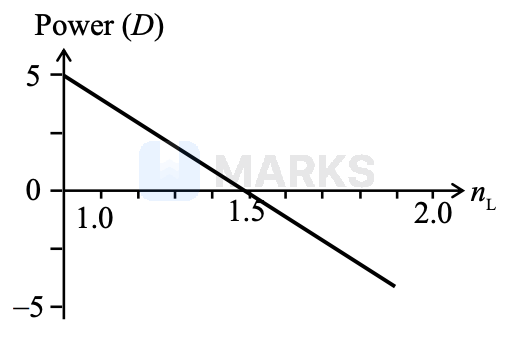
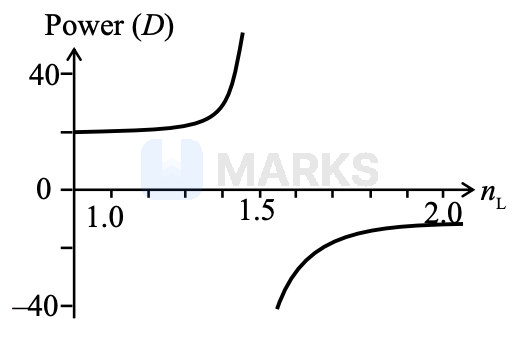
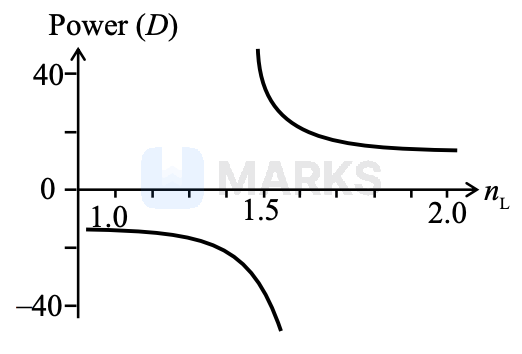
This equation represents a hyperbola, indicating that the graph of $P$ versus $n_L$ is a curve, not a straight line.
Evaluating the power at specific values of $n_L$ yields $P = 5 \text{ D}$ at $n_L = 1.0$, $P = 0 \text{ D}$ at $n_L = 1.5$, and $P = -2.5 \text{ D}$ at $n_L = 2.0$.
The second derivative $\dfrac{d^2P}{dn_L^2} = \dfrac{30}{n_L^3}$ is positive for $n_L > 0$, meaning the curve is concave upwards.
The correct plot shows a concave upwards curve passing through $(1.0, 5)$, $(1.5, 0)$, and $(2.0, -2.5)$.
Answer:
Hence, the correct answer is option: 'A'.