Q159 / 180 · COMEDK 2019 · Physics
A cylinder of radius $r$ and length $l$ is placed in an uniform electric field $E$ parallel to the axis of the cylinder. The total flux for the surface of the cylinder is given by
- A$\pi r^{2} E$
- B$\left(\pi r^{2}+\tau l^{2}\right) E$
- Correct answerCZero
- D$2 \pi r^{2} E$
Solution
The given diagram represents a cylinder placed in a uniform electric field.
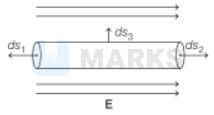
Let $\phi_{1}$ and $\phi_{2}$ be the flux coming out of a circular cross-sectional surface. $\phi_{3}$ is flux through the curved surface. Since, normal to a curved surface is always $90^{\circ}$ to electric field $\mathbf{E}$, so $\phi_{3}=E d s_{3} \cos \theta=E d s_{3} \cos 90^{\circ}=0$ $\phi_{1}$ and $\phi_{2}$ are equal and opposite to each other, hence $\phi_{1}+\phi_{2}=0$ So, total flux through the surface of cylinder is zero.
Let $\phi_{1}$ and $\phi_{2}$ be the flux coming out of a circular cross-sectional surface. $\phi_{3}$ is flux through the curved surface. Since, normal to a curved surface is always $90^{\circ}$ to electric field $\mathbf{E}$, so $\phi_{3}=E d s_{3} \cos \theta=E d s_{3} \cos 90^{\circ}=0$ $\phi_{1}$ and $\phi_{2}$ are equal and opposite to each other, hence $\phi_{1}+\phi_{2}=0$ So, total flux through the surface of cylinder is zero.
Hence, the correct answer is option: 'C'.