Q148 / 150 · MHT CET 2025 (20 Apr Shift 2) · Physics
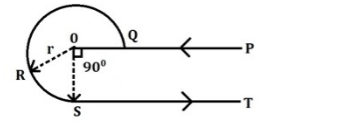
A current ' I ' is flowing in a conductor PQRST as shown in figure. The radius of curved path QRS is ' R ' and length of straight portion PQ and ST is very large. The magnetic field at the centre [O] of the curved part is ($\mu_0=$ permeability of free space)
- A$\frac{\mu_0 \mathrm{i}}{4 \pi \mathrm{r}}\left(\frac{3 \pi}{2}+1\right)(-\widehat{\mathrm{k}})$
- Correct answerB$\frac{\mu_0 \mathrm{i}}{4 \pi \mathrm{r}}\left(\frac{3 \pi}{2}+1\right) \widehat{\mathrm{k}}$
- C$\frac{\mu_0 \mathrm{i}}{4 \pi \mathrm{r}}\left[\frac{3 \pi}{2}-1\right](-\widehat{\mathrm{k}})$
- D$\frac{\mu_0 \mathrm{i}}{4 \pi \mathrm{r}}\left[\frac{3 \pi}{2}-1\right] \hat{\mathrm{k}}$
Solution
The total magnetic field at point O is found by summing contributions from all conductor segments. The circular arc QRS contributes $B_\text{QRS} = \frac{\mu_0 I}{4\pi r} \left(\frac{3\pi}{2}\right) (-\hat{k})$ using the formula for a current-carrying arc with subtended angle $270^\circ$.
The straight segment PQ contributes $B_\text{PQ} = 0$ since point O lies along its axis, making $d\vec{l} \parallel \vec{r}$ throughout.
The semi-infinite segment ST contributes $B_\text{ST} = \frac{\mu_0 I}{4\pi r} (+\hat{k})$ at perpendicular distance $r$.
The vector sum gives
$B_\text{total} = \frac{\mu_0 I}{4\pi r} \left[-\frac{3\pi}{2} + 1\right] \hat{k} = \frac{\mu_0 I}{4\pi r} \left[1 - \frac{3\pi}{2}\right] \hat{k}$
This matches option C.
Hence, the correct answer is option: 'B'.