Q120 / 180 · NEET 2026 (Re-NEET) · Physics
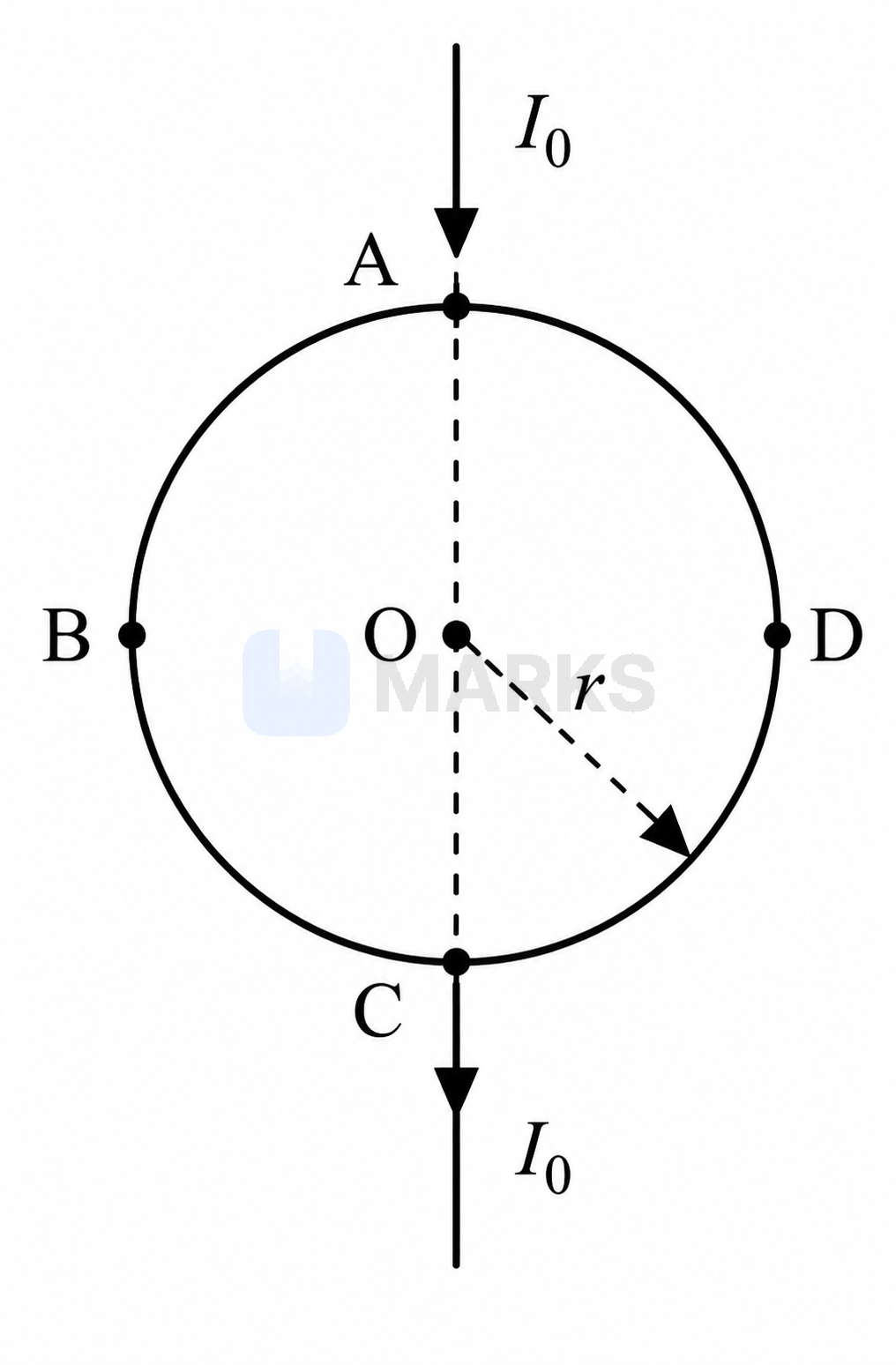
A current $I_0$ flows through a metallic circular loop of radius $r$ as shown in the figure. Resistance of the segment ABC is half that of ADC. Magnitude of magnetic field at the center O of the loop is :
- A$\dfrac{\mu_0 I_0}{2\pi r}$
- Correct answerB$\dfrac{\mu_0 I_0}{12r}$
- C$\dfrac{\mu_0 I_0}{4r}$
- D$\dfrac{\mu_0 I_0}{2r}$
Solution
From the given figure, the dashed line passing through A, O, and C is straight, indicating that the segments ABC and ADC are semicircles.
Let the resistance of segment ADC be $R_{ADC} = 2R$. Given that the resistance of segment ABC is half that of ADC, we have $R_{ABC} = R$.
The total current $I_0$ splits at point A into two parallel branches. Let $I_1$ be the current through ABC and $I_2$ be the current through ADC.
Since the branches are in parallel, the potential difference across them is equal:
$I_1 R_{ABC} = I_2 R_{ADC}$
$I_1 (R) = I_2 (2R) \Rightarrow I_1 = 2I_2$
Applying Kirchhoff's current law at junction A:
$I_1 + I_2 = I_0$
$2I_2 + I_2 = I_0 \Rightarrow 3I_2 = I_0 \Rightarrow I_2 = \dfrac{I_0}{3}$
Consequently, $I_1 = \dfrac{2I_0}{3}$.
The magnetic field at the center of a semicircle carrying current $I$ is given by $B = \dfrac{\mu_0 I}{4r}$.
For the left semicircle ABC, the current $I_1$ flows in a counter-clockwise direction. By the right-hand rule, its magnetic field at O is directed out of the plane:
$B_1 = \dfrac{\mu_0 I_1}{4r} = \dfrac{\mu_0}{4r} \left(\dfrac{2I_0}{3}\right) = \dfrac{\mu_0 I_0}{6r}$
For the right semicircle ADC, the current $I_2$ flows in a clockwise direction. Its magnetic field at O is directed into the plane:
$B_2 = \dfrac{\mu_0 I_2}{4r} = \dfrac{\mu_0}{4r} \left(\dfrac{I_0}{3}\right) = \dfrac{\mu_0 I_0}{12r}$
The straight wire segments carrying current $I_0$ into A and out of C lie on the line passing through O, so they do not contribute to the magnetic field at O.
The net magnetic field at the center O is the difference between $B_1$ and $B_2$ since they are in opposite directions:
$B_{net} = B_1 - B_2 = \dfrac{\mu_0 I_0}{6r} - \dfrac{\mu_0 I_0}{12r} = \dfrac{2\mu_0 I_0 - \mu_0 I_0}{12r} = \dfrac{\mu_0 I_0}{12r}$
Answer: $\dfrac{\mu_0 I_0}{12r}$
Hence, the correct answer is option: 'B'.