Q39 / 180 · COMEDK 2026 (9 May Shift 2) · Chemistry
A compound [X] undergoes reactions as given. Identify compounds [C] and [D] formed in these reactions.
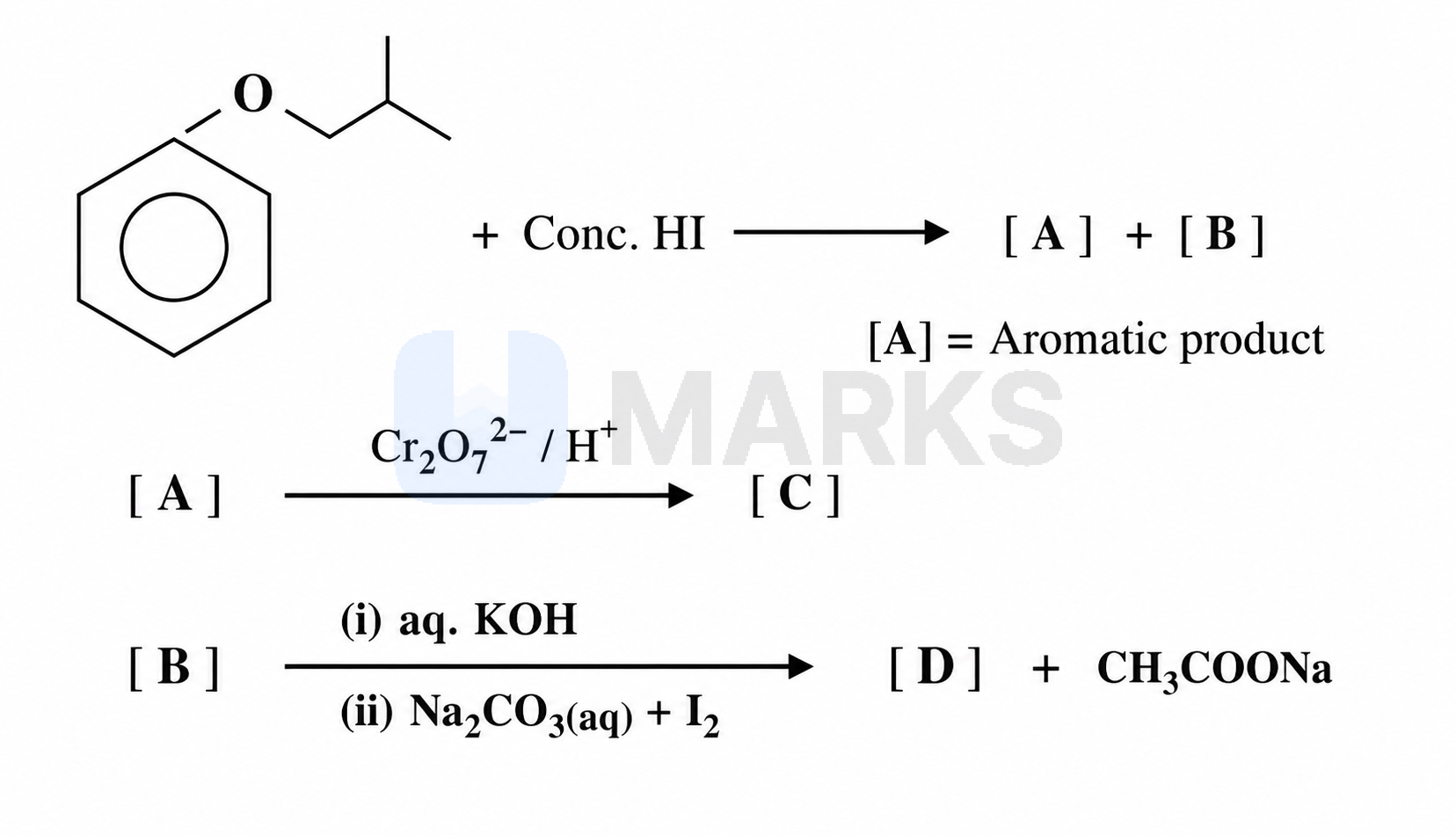
- A[C]: Benzoic acid [D]: Iodoform
- B[C]: Benzene [D]: 2-iodo-propane
- Correct answerC[C]: Benzoquinone [D]: Iodoform
- D[C]: 4–Iodophenol [D]: 1-iodo-propane
Solution
The given starting compound is isopropyl phenyl ether, $Ph-O-CH(CH_3)_2$.
Reaction with concentrated HI leads to the cleavage of the ether. Due to the partial double bond character of the O-phenyl bond (arising from resonance), the cleavage occurs at the O-isopropyl bond. This yields phenol and isopropyl iodide.
$Ph-O-CH(CH_3)_2 + HI \rightarrow PhOH + CH_3-CH(I)-CH_3$
Since [A] is the aromatic product, [A] is Phenol and [B] is Isopropyl iodide.
Phenol [A] undergoes oxidation with acidified dichromate ($Cr_2O_7^{2-} / H^+$) to form p-benzoquinone.
Therefore, [C] is Benzoquinone.
Isopropyl iodide [B] reacts with aqueous KOH to undergo nucleophilic substitution, forming isopropyl alcohol.
$CH_3-CH(I)-CH_3 + aq. KOH \rightarrow CH_3-CH(OH)-CH_3$
Isopropyl alcohol contains the $CH_3-CH(OH)-$ group, which gives a positive iodoform test when treated with $I_2$ and a base like $Na_2CO_3$. The reaction produces iodoform and the sodium salt of the corresponding carboxylic acid (sodium acetate).
$CH_3-CH(OH)-CH_3 + I_2 + Na_2CO_3 \rightarrow CHI_3 + CH_3COONa$
Therefore, [D] is Iodoform.
Answer: [C]: Benzoquinone [D]: Iodoform
Hence, the correct answer is option: 'C'.