Q18 / 120 · VITEEE 2015 · Chemistry
A compound $X$ on heating gives a colourless gas. The residue is dissolved in water to obtain $Y$. Excess $\mathrm{CO}_{2}$ is passed through aqueous solution of $Y$ when $Z$ is formed. $Z$ on gentle heating gives back $X$. The compound $X$ is
- A$\mathrm{Ca}\left(\mathrm{HCO}_{3}\right)_{2}$
- Correct answerB$\mathrm{CaCO}_{3}$
- C$\mathrm{NaHCO}_{3}$
- D$\mathrm{Na}_{2} \mathrm{CO}_{3}$
Solution
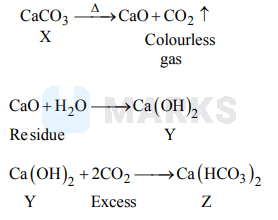
$\mathrm{Ca}\left(\underset{\mathrm{Z}}{\mathrm{HCO}_{3}}\right)_{2} \stackrel{\Delta}{\longrightarrow} \underset{\mathrm{x}}{\mathrm{CaCO}_{3}}+\mathrm{CO}_{2} \uparrow+\mathrm{H}_{2} \mathrm{O}$
Hence, the correct answer is option: 'B'.