Q144 / 150 · MHT CET 2024 (03 May Shift 2) · Physics
A charge $+Q$ is placed at each of the diagonally opposite corners of a square. A charge -q is placed at each of the other diagonally opposite corners as shown. If the net electrical force on $+Q$ is zero, then $\frac{+Q}{-q}$ is equal to
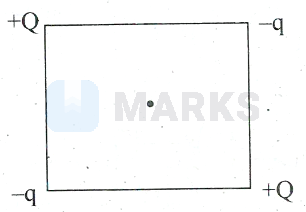
- A+1
- Correct answerB$+2 \sqrt{2}$
- C$\frac{+1}{\sqrt{2}}$
- D$-2 \sqrt{2}$
Solution
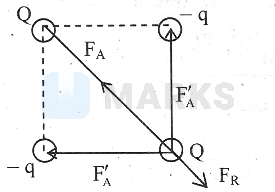
From the diagram, $\begin{aligned} & \left(\mathrm{F}_{\mathrm{A}}\right)^2=\left(\mathrm{F}_{\mathrm{R}}\right)^2 \Rightarrow 2\left(\mathrm{~F}_{\mathrm{A}}\right)^2=\mathrm{F}_{\mathrm{R}}{ }^2 \\ & \therefore \quad \sqrt{2}\left(F_A{ }^{\prime}\right)=F_R \\ & \therefore \quad \frac{1}{4 \pi \varepsilon_0} \frac{\sqrt{2} \mathrm{Q}(-\mathrm{q})}{\mathrm{a}^2}=\frac{1}{4 \pi \varepsilon_0} \frac{\mathrm{Q}^2}{2 \mathrm{a}^2} \\ & \therefore \quad Q=-2 \sqrt{2} q \\ & \therefore \quad \frac{\mathrm{Q}}{\mathrm{q}}=\frac{-2 \sqrt{2}}{1} \\ & \frac{Q}{-q}=2 \sqrt{2} \end{aligned}$
Hence, the correct answer is option: 'B'.