Q134 / 180 · AIIMS 2010 · Physics
A block of mass $m$ is pulled along a horizontal surface by applying a force at an angle $\theta$ with the horizontal. If the block travels with a uniform velocity and has a displacement $d$ and the coefficient of friction is $\mu$, then the work done by the applied force is
- A$\frac{\mu m g d}{\cos \theta+\mu \sin \theta}$
- Correct answerB$\frac{\mu m g d \cos \theta}{\cos \theta+\mu \sin \theta}$
- C$\frac{\mu m g d \sin \theta}{\cos \theta+\mu \sin \theta}$
- D$\frac{\mu m g d \cos \theta}{\cos \theta-\mu \sin \theta}$
Solution
Because the block moves with a uniform velocity, the resultant force is zero. Resolving $F$ into horizontal component $F \cos \theta$ and vertical component $F \sin \theta$, we get
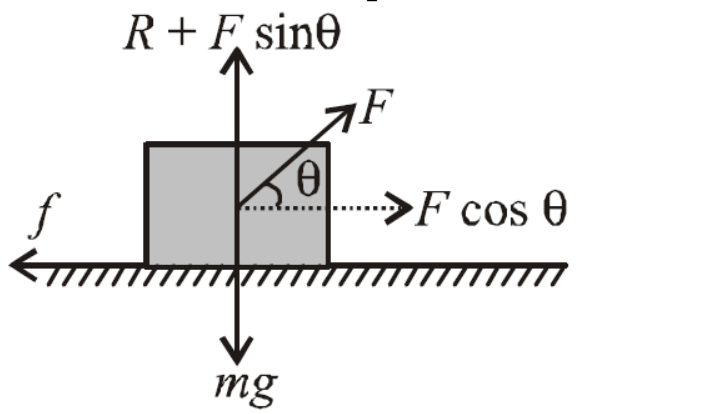
$$ \begin{aligned} & R+F \sin \theta=m g \text { or } R=m g-F \sin \theta \\ & \text { Also } f=\mu R=\mu(m g-F \sin \theta) \\ & \text { But } F \cos \theta=f \\ & \text { or } F \cos \theta=\mu(m g-F \sin \theta) \\ & \text { or } F(\cos \theta+\mu \sin \theta)=\mu m g \\ & \therefore \quad F=\frac{\mu m g}{\cos \theta+\mu \sin \theta} \end{aligned} $$ Work $W=F s \cos \theta$ $$ \begin{aligned} & \therefore W=\frac{\mu m g d \cos \theta}{\cos \theta+\mu \sin \theta} \\ & (\because s=d) \end{aligned} $$
$$ \begin{aligned} & R+F \sin \theta=m g \text { or } R=m g-F \sin \theta \\ & \text { Also } f=\mu R=\mu(m g-F \sin \theta) \\ & \text { But } F \cos \theta=f \\ & \text { or } F \cos \theta=\mu(m g-F \sin \theta) \\ & \text { or } F(\cos \theta+\mu \sin \theta)=\mu m g \\ & \therefore \quad F=\frac{\mu m g}{\cos \theta+\mu \sin \theta} \end{aligned} $$ Work $W=F s \cos \theta$ $$ \begin{aligned} & \therefore W=\frac{\mu m g d \cos \theta}{\cos \theta+\mu \sin \theta} \\ & (\because s=d) \end{aligned} $$
Hence, the correct answer is option: 'B'.