Q171 / 180 · COMEDK 2023 (Memory Based) · Physics
A balloon with mass $m$ is descending down with an acceleration $a$ (where, $a < g$ ). How much mass should be removed from it so that it starts moving up with an acceleration $a$ ?
- Correct answerA$\frac{2 m a}{g+a}$
- B$\frac{2 m a}{g-a}$
- C$\frac{m a}{g+a}$
- D$\frac{m a}{g-a}$
Solution
When the balloon is descending down with an acceleration $a$,

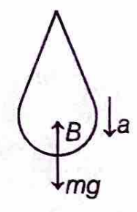
where, $B=$ buoyant force. Here, we should assume that while removing some mass the volume of balloon and hence buoyant force will not change. Let the new mass of the balloon is $m^{\prime}$, so
On solving Eqs. (i) and (ii), we get $\begin{aligned} & m g-m^{\prime} g=m a+m^{\prime} a \\ \Rightarrow \quad & m(g-a)=m^{\prime}(g+a) \Rightarrow m^{\prime}=\frac{m(g-a)}{g+a} \end{aligned}$ So, mass removed, $\Delta m=m-m^{\prime}$ $=m\left[1-\frac{(g-a)}{(g+a)}\right]=m\left[\frac{g+a-g+a}{g+a}\right]=\frac{2 m a}{g+a}$
where, $B=$ buoyant force. Here, we should assume that while removing some mass the volume of balloon and hence buoyant force will not change. Let the new mass of the balloon is $m^{\prime}$, so
On solving Eqs. (i) and (ii), we get $\begin{aligned} & m g-m^{\prime} g=m a+m^{\prime} a \\ \Rightarrow \quad & m(g-a)=m^{\prime}(g+a) \Rightarrow m^{\prime}=\frac{m(g-a)}{g+a} \end{aligned}$ So, mass removed, $\Delta m=m-m^{\prime}$ $=m\left[1-\frac{(g-a)}{(g+a)}\right]=m\left[\frac{g+a-g+a}{g+a}\right]=\frac{2 m a}{g+a}$
Hence, the correct answer is option: 'A'.