Q116 / 160 · JIPMER 2007 · Physics
A ball is thrown vertically upward. It has a speed of $10 \mathrm{~m} / \mathrm{s}$ when it has reached one-half of its maximum height. How high does the ball rise? (Take, $g=10 \mathrm{~m} / \mathrm{s}^2$ )
- A15 m
- Correct answerB10 m
- C20 m
- D5 m
Solution
The problem can be solved using third equation of motion at $A$ and $O$ '.
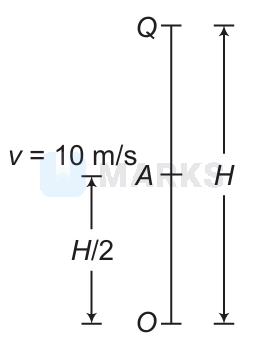 Let maximum height attained by the ball be H.Third equation of motion gives $v^2=u^2-2 g h$
At $A$, $(10)^2=u^2-2 \times 10 \times \frac{H}{2}$
$\Rightarrow u^2=100+10 H...(i)$
At $O^{\prime},(0)^2=u^2-2 \times 10 \times H$
$\Rightarrow u^2=20 H...(ii)$
Thus, from Eqs. (i) and (ii), we get
$20 H=100+10 H$
$\Rightarrow 10 H=100 \quad \therefore H=10 \mathrm{~m}$
Let maximum height attained by the ball be H.Third equation of motion gives $v^2=u^2-2 g h$
At $A$, $(10)^2=u^2-2 \times 10 \times \frac{H}{2}$
$\Rightarrow u^2=100+10 H...(i)$
At $O^{\prime},(0)^2=u^2-2 \times 10 \times H$
$\Rightarrow u^2=20 H...(ii)$
Thus, from Eqs. (i) and (ii), we get
$20 H=100+10 H$
$\Rightarrow 10 H=100 \quad \therefore H=10 \mathrm{~m}$Hence, the correct answer is option: 'B'.